
Diamond Life CFB DFS — Complete Slate Edge Report
November 14, 2026 | 334-player slate | Vegas × Monte Carlo × SACP × Right-Tail Separation
Executive summary
After reviewing the uploaded slate and our Diamond Life solver workbook, the biggest advantage is attacking individual ceiling efficiency rather than blindly stacking the highest-total games.
The model favors a receiver-heavy tournament strategy, selective spending at quarterback, and finding players whose extreme outcomes are stronger than their game totals suggest.
Three conclusions stand out:
- Charlie Becker is the strongest overall salary-adjusted ceiling play. His $9,000 salary, 49.1 SACP, and 68.6 P99 are an exceptional combination.
- Devon Dampier and Darian Mensah are the premium quarterback priorities. Dampier offers rushing-driven upside, while Mensah benefits from Miami’s strong implied scoring environment.
- Indiana–USC and LSU–Texas deserve more attention than their game totals alone suggest. Becker, Nick Marsh, and Jackson Harris demonstrate meaningful individual ceiling opportunities.
1. Best overall ceiling plays
SACP = Solver-Adjusted Ceiling Projection; P99 = modeled extreme-tail outcome.
| Rank | Player | Salary | SACP | P99 |
|---|---|---|---|---|
| 1 | Jeremiah Smith, WR | $11,100 | 55.8 | 77.4 |
| 2 | Charlie Becker, WR | $9,000 | 49.1 | 68.6 |
| 3 | Darian Mensah, QB | $11,500 | 46.6 | 58.8 |
| 4 | Devon Dampier, QB | $11,600 | 45.0 | 56.3 |
| 5 | Jackson Harris, WR | $9,700 | 44.8 | 62.8 |
| 6 | Lincoln Kienholz, QB | $11,300 | 43.2 | 53.9 |
| 7 | Cooper Barkate, WR | $8,300 | 42.6 | 59.8 |
| 8 | Sam Leavitt, QB | $11,000 | 42.5 | 53.1 |
| 9 | Kevin Jennings, QB | $11,800 | 42.1 | 52.7 |
| 10 | Bear Bachmeier, QB | $10,300 | 40.8 | 50.9 |
Key advantage: Jeremiah Smith has the highest raw ceiling, but Becker saves $2,100 while retaining substantial tournament-winning upside. That salary difference creates meaningful flexibility elsewhere.
2. Best value plays and salary efficiency
Top salary-adjusted ceiling plays
SACP per $1,000 salary; larger values indicate more modeled ceiling for the cost.
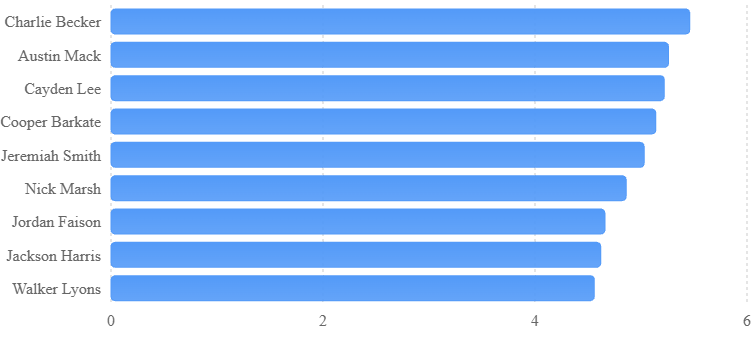
My preferred value targets:
- Charlie Becker ($9,000): Best combination of ceiling, salary efficiency, and extreme-tail separation.
- Cooper Barkate ($8,300): Excellent way to access Miami’s projected scoring without paying premium receiver prices.
- Cayden Lee ($7,500): One of the best midrange salary-adjusted ceiling plays.
- Nick Marsh ($7,600): Strong secondary receiver value within the Indiana–USC environment.
- Austin Mack ($5,900): Potentially exceptional quarterback salary relief, but only if his role and playing time are confirmed.
3. Best tournament sleepers
These players stand out because of their salary-adjusted upside, not because low ownership has been verified.
| Player | Salary | Edge |
|---|---|---|
| Walker Lyons, WR | $5,500 | Cheap P90–P99 separation |
| Elija Lofton, WR | $6,400 | Mid-low salary ceiling efficiency |
| Jamari Johnson, WR | $6,700 | Strong extreme-tail separation |
| Jelani Thurman, WR | $7,300 | Useful midrange alternative |
| Junior Sherrill, WR | $7,600 | Competitive salary-adjusted upside |
| Jordan Faison, WR | $7,900 | Balanced value and upper-tail access |
Walker Lyons is my favorite inexpensive sleeper candidate from the modeled right-tail metrics. He can provide salary flexibility without completely sacrificing upside.
However, his projected opportunity and actual role should be checked before using him heavily.
4. Best game environments — adjusted for solver upside
Utah QB Devon Dampier not on availability report, reportedly expected to start – Deseret News
1. Utah–Arizona
Top QB environment
O/U 55.5 | Spread 1.5
Devon Dampier’s 45.0 SACP, rushing opportunities, and competitive game script make this a leading Superflex environment. Noah Fifita is an alternative way to gain exposure.
3 biggest takeaways from Miami’s huge win over Notre Dame
2. Miami–Duke
O/U 54.5 | Miami implied 34.25
Darian Mensah and Cooper Barkate provide an appealing quarterback-receiver correlation. The 14-point spread introduces blowout risk, but Miami’s scoring expectation supports their ceilings.
3. Indiana–USC
O/U 50.5 | Indiana implied 30
Becker’s 49.1 SACP and Marsh’s salary-adjusted upside create one of the strongest individual receiver environments. A high-priority alternative to the obvious high-total stacks.
OPINION: Ten favorite shots from 2024 Cardinals football – The Louisville Cardinal
4. Louisville–UNC
O/U 58.0 | Spread 3.5
Lincoln Kienholz has a 43.2 SACP. Billy Edwards offers an alternative quarterback price point in a game with substantial projected scoring.
Kevin Jennings – Football – SMU Athletics
5. SMU–Wake Forest
O/U 60.5 | Highest uploaded total
Kevin Jennings has a 42.1 SACP, but his $11,800 salary makes him less efficient than several alternatives. A good selective stack rather than an automatic core.
5. Right-tail MME separation — where tournament winners can emerge
P99 minus P90, divided by salary in thousands. Higher values represent more extreme upside beyond the P90 outcome.
| Player | Separation |
|---|---|
| Charlie Becker | 3.37 |
| Cooper Barkate | 3.20 |
| Cayden Lee | 3.14 |
| Nick Marsh | 3.09 |
| Jeremiah Smith | 3.05 |
| Walker Lyons | 2.92 |
| Jordan Faison | ~2.9 |
| Jackson Harris | ~2.9 |
This is one of the most useful results of the full analysis.
Becker, Barkate, and Lee all offer excellent salary-adjusted access to extreme outcomes. That makes them attractive for MME and 3-Max construction, especially when deciding whether to sacrifice an expensive quarterback for another high-ceiling receiver.
6. The most interesting strategic advantages
Edge A — Receiver ceilings may be more valuable than a second premium QB.
Smith, Becker, Barkate, and Harris have modeled upper tails that justify prioritizing receiver spending. The Superflex position should be evaluated against those alternatives rather than automatically filled with the second-most-expensive quarterback.
Edge B — The highest-total game may produce inefficient chalk.
SMU–Wake Forest leads at 60.5, but Jennings’ 42.1 SACP is below Mensah’s 46.6 and Dampier’s 45.0. If ownership heavily favors the highest-total matchup, the alternatives become even stronger.
Edge C — Lower-total games can produce elite individual outcomes.
Smith’s Ohio State matchup and Harris’s LSU–Texas matchup illustrate why targeting opportunities and player-specific ceiling can outperform a simple game-total approach.
Edge D — Conditional quarterback salary relief creates substantial opportunity cost savings.
Austin Mack costs $5,900, compared with $11,600 for Dampier. That $5,700 difference could dramatically improve the receiving group, although Mack’s starting status and playing time are essential to validate.
Edge E — Game stacks and one-offs should serve different purposes.
Mensah–Barkate offers a coherent same-team correlation candidate. Becker, Smith, and Harris can be considered as premium one-offs without requiring full game stacks.
7. My final Diamond Life tournament board
PRIORITY PLAYER POOL
| Category | Selection |
| Best raw ceiling | Jeremiah Smith |
| Best overall value | Charlie Becker |
| Best premium QB | Devon Dampier |
| Best QB stack | Mensah + Barkate |
| Best midrange WR | Cayden Lee |
| Best contrarian ceiling | Jackson Harris |
| Best cheap sleeper | Walker Lyons |
| Best conditional punt QB | Austin Mack |
| Best balanced game | Utah–Arizona |
| Best overlooked environment | Indiana–USC |
8. Single-entry versus 3-Max approach
For single-entry, I favor building around one of Dampier or Mensah, then prioritizing Becker and a second high-ceiling receiver. The biggest decision is whether Smith’s raw ceiling justifies his salary versus Barkate or Cayden Lee.
For 3-Max, I would diversify the main quarterback environments across Utah–Arizona, Miami–Duke, and Louisville–UNC. Use Indiana–USC receiver exposure and Jackson Harris as alternative ceiling paths rather than simply repeating the same expensive stack in every entry.
For large-field MME, the strongest candidates for additional exposure investigation are Becker, Barkate, Lee, Marsh, and Walker Lyons because their modeled salary-adjusted right tails are compelling.
These are strategic exposure candidates, not calculated optimal exposure percentages.
Final verdict
My strongest overall play is Charlie Becker. My preferred premium quarterback is Devon Dampier. My favorite correlated stack is Darian Mensah with Cooper Barkate.
The main slate advantage is combining high-upside receivers with carefully selected quarterback exposure instead of spending indiscriminately on the games with the highest totals.
One final distinction matters: the workbook has no authoritative RST% ownership feed, and the simulation is a projection-based approximation. We have identified strong ceiling and salary-efficiency edges, but we cannot yet confirm which ones are genuinely under-owned or assign precise tournament-winning probabilities.
That ownership validation, together with final starting-lineup and injury confirmation, is what would turn this candidate pool into a sharper lock-time tournament strategy.


Leave a Reply