
Diamond Life CFB DFS — Complete Slate Edge Report
November 14, 2026 | DraftKings | Single-Entry, 3-Max & MME
The strongest opportunity on this slate is finding players whose individual ceilings exceed what their game environments might suggest, while using high-scoring games to identify correlated tournament upside.
I reviewed the 276-player Diamond Life CFB Solver output, including SACP, P90–P99, salary-adjusted ceiling, and the Vegas information included in the original slate.
1. Top 10 tournament-winning ceiling plays
These are the players with the highest Solver-Adjusted Ceiling Projections.
| Rank | Player | Salary | SACP | P99 |
|---|---|---|---|---|
| 1 | Jeremiah Smith, WR | $9,300 | 71.4 | 100.5 |
| 2 | DeSean Bishop, RB | $8,700 | 62.5 | 83.9 |
| 3 | Charlie Becker, WR | $8,300 | 62.3 | 86.3 |
| 4 | Cardae Mack, RB | $7,500 | 59.3 | 79.6 |
| 5 | Aiden Flora, RB | $8,500 | 58.6 | 78.3 |
| 6 | Darian Mensah, QB | $9,500 | 55.3 | 71.4 |
| 7 | Cole Tabb, RB | $8,100 | 51.9 | 70.8 |
| 8 | Cooper Barkate, WR | $7,300 | 51.7 | 72.7 |
| 9 | Nate Sheppard, RB | $9,200 | 51.2 | 67.6 |
| 10 | Kevin Jennings, QB | $9,000 | 50.5 | — |
SACP and P99 are simulated fantasy-point estimates, not guarantees. The model’s extreme tails depend on its variance assumptions.
How I would prioritize them
Jeremiah Smith is the strongest raw-ceiling weapon. His 71.4 SACP is substantially above the rest of the slate, and his target projection supports that upside.
Cardae Mack is my favorite salary-adjusted foundation. He offers a 59.3 SACP for $7,500, saving $1,800 compared with Smith.
Charlie Becker is the premium receiver alternative. He carries an 86.3 P99 at $8,300 and plays for an Indiana offense with a 30-point implied team total.
DeSean Bishop is an important tournament exception: Tennessee has only a 22.5 implied team total, but his individual ceiling ranks second. He deserves attention as a concentrated-production play rather than a game-stack centerpiece.
2. Best values and diamonds in the rough
Value is projected fantasy points per $1,000 of DraftKings salary.
| Player | Salary | Value | P99 | Edge |
|---|---|---|---|---|
| Derek Eusebio, WR | $3,000 | 4.09x | 40.6 | Minimum-salary upside |
| Jamari Johnson, WR | $4,100 | 3.89x | 52.7 | Cheap explosive ceiling |
| Walker Lyons, WR | $3,700 | 3.79x | 46.8 | BYU value |
| Elija Lofton, WR | $4,300 | 3.58x | 51.3 | Miami stack value |
| Malachi Henry, WR | $4,200 | 3.20x | 44.6 | Cincinnati game exposure |
| Caleb Odom, WR | $4,000 | 3.19x | 43.0 | Low-cost tournament option |
Three players particularly interest me:
- Derek Eusebio: Best pure salary relief, especially when paying for premium receivers.
- Jamari Johnson: My favorite inexpensive right-tail candidate because his $4,100 salary creates significant tournament flexibility.
- Elija Lofton: The most useful correlated value, allowing exposure to Miami’s strong implied scoring environment without paying for two premium players.
These values are not interchangeable. Eusebio is primarily a roster-construction tool, Johnson offers independent upside, and Lofton is especially useful in a Miami passing stack.
3. Game environments that create the strongest edges
Top game totals
Vegas totals supplied in the uploaded slate.
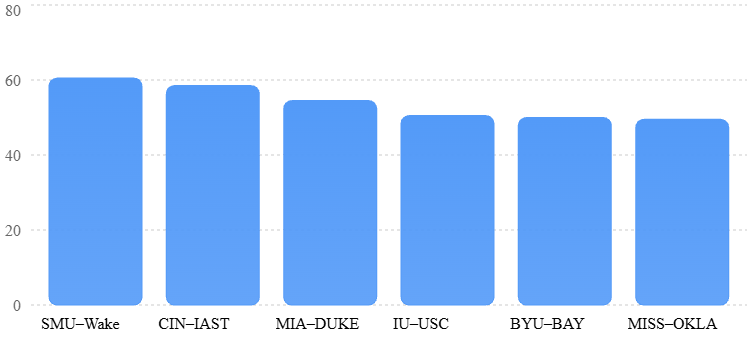
| Game | DFS advantage | Preferred exposure |
|---|---|---|
| SMU–Wake Forest | Highest overall scoring environment | Kevin Jennings, Carlos Hernandez |
| Cincinnati–Iowa State | Two strong RB ceiling profiles | Aiden Flora, Cole Tabb |
| Miami–Duke | Best premium QB/WR correlation | Darian Mensah, Cooper Barkate, Elija Lofton |
| Indiana–USC | Elite individual WR ceiling | Charlie Becker, Trent Mosley |
| BYU–Baylor | Lower-cost WR and QB opportunities | Bear Bachmeier, Walker Lyons |
| Ole Miss–Oklahoma | Superflex salary flexibility | John Mateer, Trinidad Chambliss |
My top game environment is Miami–Duke for passing stacks, while Cincinnati–Iowa State is the leading game for running-back exposure.
SMU–Wake Forest remains important, but the highest total alone is not enough to make it the automatic first choice.
4. Five under-the-radar tournament edges
Cardae Mack — Concentrated RB production
Arizona State’s implied total is only 22, yet Mack carries a 59.3 SACP. The solver is projecting individual opportunity well beyond what the team total alone would suggest.
Best use: Core RB in single-entry and 3-Max.
DeSean Bishop — Ceiling without a shootout
His 62.5 SACP ranks second overall despite Tennessee’s modest scoring expectation. He could be especially valuable if opponents overemphasize high-total games.
Best use: Premium RB alternative to the obvious game environments.
Jamari Johnson — Low-total, high-upside receiver
Oregon–Michigan has a 38.5 total, but Johnson has a 52.7 modeled P99 and costs only $4,100.
Best use: Large-field tournament salary relief with upside.
Walker Lyons — BYU salary efficiency
A $3,700 receiver with a 46.8 modeled P99 and 3.79x baseline value. BYU’s 29.25 implied total provides a favorable team environment.
Best use: Value WR in balanced or premium-QB builds.
John Mateer — Superflex opportunity cost
His $6,600 salary and 39.1 SACP create a different path to tournament upside. The savings compared with Mensah can fund a meaningful receiver upgrade.
Best use: Salary-conscious Superflex construction.
5. Best QB stacks and correlation plays
| Stack | Combined salary | Why it works |
|---|---|---|
| Mensah + Barkate | $16,800 | Premium Miami passing ceiling |
| Mensah + Lofton | $13,800 | Lower-cost Miami stack |
| Jennings + Wake Forest bring-back | Varies | Highest-total game exposure |
| Bachmeier + Lyons | $11,800 | Value-oriented BYU correlation |
The Mensah–Lofton combination is particularly interesting. It saves $3,000 compared with Mensah–Barkate, allowing the rest of the lineup to access another premium ceiling player.
However, Barkate has the stronger individual solver projection. The cheaper combination is a roster-construction alternative, not automatically the better stack.
6. Opportunity cost: where spending salary matters
Premium WR decision
Jeremiah Smith
71.4
SACP · $9,300
Charlie Becker
62.3
SACP · $8,300
Smith provides approximately 9.2 additional modeled SACP points for $1,000 more. Whether that upgrade is worthwhile depends on what the $1,000 can accomplish elsewhere.
The same principle applies at quarterback. Paying $9,500 for Mensah instead of $6,600 for Mateer buys approximately 16.2 SACP points but costs $2,900.
That is why the best lineup is not necessarily the one containing the greatest number of top-ranked players.
7. Recommended exposure strategy
Choose your tournament format
Single Entry3-MaxMME
Single-entry core strategy
Build around Mack’s salary efficiency and one of Smith or Becker. Use Miami as a premium passing-stack option, or Mateer at Superflex to preserve spending power.
Prioritize concentrated production and avoid excessive exposure to one game script.
8. Final Diamond Life priority board
| Category | Top choice | Alternative |
|---|---|---|
| Highest raw ceiling | Jeremiah Smith | Charlie Becker |
| Best RB value/upside | Cardae Mack | DeSean Bishop |
| High-total RB | Aiden Flora | Cole Tabb |
| Premium QB | Darian Mensah | Kevin Jennings |
| Value Superflex | John Mateer | Luke Fahey |
| Best inexpensive WR | Jamari Johnson | Walker Lyons |
| Salary punt | Derek Eusebio | Caleb Odom |
| Best passing stack | Miami | SMU |
| Best RB game environment | Cincinnati–Iowa State | — |
| Lower-total ceiling play | Jeremiah Smith | DeSean Bishop |
Bottom line: The five edges I would build around
1. Cardae Mack
Salary-adjusted core
2. Jeremiah Smith
Slate-breaking ceiling
3. Charlie Becker
Premium WR pivot
4. Mensah + Miami WR
Correlated upside
5. Jamari Johnson
Inexpensive right-tail upside
The most interesting slate-wide advantage: Several of the strongest individual ceilings appear outside the highest-total games. That creates potential leverage against opponents who construct their lineups primarily around Vegas totals.
The important qualification is that actual ownership projections are missing. We have identified potential ownership inefficiencies, not proven underowned players. Also, the uploaded slate’s projections and betting lines have not been independently verified against live injury reports or current markets.
For this slate, I would prioritize individual ceiling concentration, salary efficiency, and meaningful quarterback-receiver correlation over blindly chasing the highest game totals.


Leave a Reply