
Diamond Life NASCAR DFS — Final Slate Edge Report
Ceiling plays | Dominators | Value | Sleepers | Race environments | Ownership leverage | SE & MME strategy
Based on our NASCAR solver projections, starting positions, salary efficiency, ownership analysis, and conditional Vegas framework, this slate offers several interesting opportunities.
The biggest advantage is targeting drivers with multiple paths to a tournament-winning score while avoiding unnecessary exposure to expensive, highly owned drivers whose ceiling is already priced into the field.
1. The five strongest slate edges
NASCAR Cup Series AdventHealth 400
Kyle Larson
Top ceiling
$11,500 · Starts 4th · 62.30 FPTS · 23.0% owned
The best projected driver on the slate. Larson has strong dominator potential without Hamlin’s ownership burden. My preferred primary anchor.
Hendrick Motorsports – Car 24 (2025)
William Byron — Best premium leverage
$9,700 · Starts 8th · 52.61 FPTS · 16.7% owned
Byron combines top-end projection, positive place-differential potential, and relatively modest ownership. One of the most compelling large-field tournament plays.
NASCAR Cup Series South Point 400
Chase Briscoe — Best pole dominator
$9,900 · Starts 1st · 56.11 FPTS · 22.9% owned
The strongest projected salary efficiency among the leading drivers at 5.67×. Particularly attractive if he converts pole position into a long opening run out front.
NASCAR Cup Series Buschy McBusch Race 400
Alex Bowman — Best midrange ownership edge
$7,300 · Starts 13th · 36.16 FPTS · 7.8% owned
Excellent projected production for a driver carrying single-digit ownership. A useful differentiator when building around expensive dominators.
NASCAR Cup Series Shriners Children’s 500 – Practice
AJ Allmendinger — Best place-differential value
$6,600 · Starts 29th · 33.66 FPTS · 11.0% owned
Starting deep in the field gives Allmendinger a route to a strong score without leading laps. One of the best supporting plays for premium-driver builds.
2. Best ceiling and dominator rankings
| Rank | Driver | Projected FPTS | Ownership | DFS assessment |
|---|---|---|---|---|
| 1 | Kyle Larson | 62.30 | 23.0% | Best overall anchor |
| 2 | Chase Briscoe | 56.11 | 22.9% | Pole dominator |
| 3 | Denny Hamlin | 55.32 | 47.3% | Strong but crowded |
| 4 | William Byron | 52.61 | 16.7% | Best leverage |
| 5 | Tyler Reddick | 49.50 | 21.8% | Alternative dominator |
| 6 | Ryan Blaney | 45.82 | 35.2% | Ownership concern |
| 7 | Chase Elliott | 38.39 | 18.3% | Secondary upside |
| 8 | Austin Cindric | 37.96 | 12.2% | Contrarian front-runner |
The most interesting tournament decision is Larson versus Hamlin. Larson projects 6.98 points higher with 24.3 percentage points less ownership. That is a substantial projection/ownership advantage before accounting for race-specific uncertainty.
3. Best value plays and sleepers
| Driver | Salary | Start | Value | Own. | Role |
|---|---|---|---|---|---|
| Chase Briscoe | $9,900 | 1 | 5.67× | 22.9% | Premium value |
| Austin Dillon | $6,300 | 21 | 5.31× | 12.6% | Salary saver |
| AJ Allmendinger | $6,600 | 29 | 5.10× | 11.0% | Place differential |
| Riley Herbst | $5,300 | 30 | 4.97× | 6.4% | Low-owned value |
| Alex Bowman | $7,300 | 13 | 4.95× | 7.8% | Midrange leverage |
| Casey Mears | $4,700 | 37 | 4.60× | 0.7% | Deep sleeper |
| Ty Dillon | $5,100 | 31 | 4.33× | 12.2% | Punt alternative |
Best overall value: Austin Dillon offers a 33.44-point projection for only $6,300.
Best sleeper: Riley Herbst combines a favorable starting position for place differential with just 6.4% ownership.
Best extreme contrarian: Casey Mears at 0.7% ownership. He is more appropriate for large-field tournaments than single-entry because his finishing reliability remains uncertain.
4. Best NASCAR race environments
Unlike NBA or NFL, NASCAR has one shared scoring environment. We therefore want to identify which race scripts concentrate the most fantasy points.
Environment 1 — Larson dominates
Best plays: Larson, Byron, Bowman, Herbst.
This is my preferred provisional GPP script. Larson captures significant dominator points while the lineup benefits from relatively low-owned supporting drivers.
Environment 2 — Briscoe controls the opening stages
Best plays: Briscoe, Larson or Reddick, Allmendinger.
Briscoe’s pole position creates a clear route to laps-led production. The critical question is whether he maintains that advantage through pit cycles and restarts.
Environment 3 — Multiple dominators
Best plays: Byron, Reddick, Cindric, Bowman.
With laps-led points spread among several drivers, finishing position and place differential become relatively more important.
Environment 4 — Cautions and attrition
Best plays: Allmendinger, Austin Dillon, Herbst, Mears.
A chaotic race can elevate inexpensive drivers who survive and gain positions. This is a high-variance tournament scenario, not a prediction that cautions will occur.
5. Biggest ownership opportunities
Projected ownership: premium-driver comparison
Lower ownership can create tournament leverage when projected ceiling remains competitive.
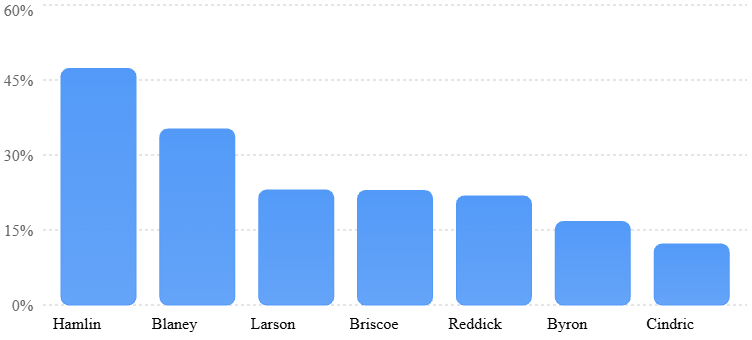
Three ownership opportunities stand out:
- Byron over Hamlin: Byron costs $1,300 less, projects only 2.71 points lower, and carries 30.6 percentage points less ownership.
- Larson over Hamlin: Larson costs $500 more but projects 6.98 points higher at substantially lower ownership.
- Bowman over popular midrange options: His 7.8% ownership and 36.16-point projection make him an attractive lineup differentiator.
These are projected ownership advantages, not confirmed positive expected-value edges. Actual leverage also depends on the probability of each driver’s ceiling outcome.
6. Most interesting fade opportunities
| Driver | Projected own. | Primary concern | Strategy |
|---|---|---|---|
| Denny Hamlin | 47.3% | Extremely popular | Underweight consideration |
| Ryan Blaney | 35.2% | Expensive relative to projection | Selective exposure |
| Christopher Bell | 29.6% | 3.40× projected value | Underweight |
| Corey Heim | 34.4% | Ownership exceeds apparent value | Underweight |
| Ty Gibbs | 21.7% | Only 16.02 projected points | Strong fade candidate |
Hamlin is the most consequential decision because his ownership is so high. If he fails to dominate, lineups featuring Larson, Byron, or Briscoe may gain significant ground.
Ty Gibbs is the clearest baseline fade based on salary efficiency, although updated practice or race information could change that assessment.
7. Diamond Life single-entry and MME construction
Single-entry core candidates
Strategic pool, not a finalized salary-cap lineup
Kyle LarsonPrimary anchor
William ByronPremium leverage
Alex BowmanMidrange
AJ AllmendingerPlace differential
Construction concept: Favor Larson as the lead dominator, then use Byron selectively alongside Bowman and Allmendinger. The remaining positions must be selected within the contest’s salary cap and roster rules.
For large-field MME, I’d build separate groups around Larson domination, Briscoe domination, and shared dominator production. Avoid forcing every premium driver into the same lineup, since their laps-led outcomes compete with one another.
8. Five important strategic conclusions
1. Larson is the strongest baseline anchor. Highest projected fantasy score, reasonable ownership, and front-running opportunity.
2. Byron is the best premium ownership pivot. His combination of salary, projection, starting position, and ownership makes him particularly interesting.
3. Bowman and Allmendinger are key lineup separators. They offer different scoring paths from the premium dominators.
4. Herbst is the preferred low-cost sleeper. Starting 30th gives him meaningful place-differential potential at low ownership.
5. Hamlin is the pivotal chalk decision. At 47.3% ownership, being underweight could create a substantial advantage if he fails to deliver a dominant performance.
Final Diamond Life priority list
Top five plays to build around
1
Kyle LarsonBest overall ceiling
2
William ByronBest premium leverage
3
Chase BriscoeBest pole dominator
4
Alex BowmanBest midrange separator
5
AJ AllmendingerBest place-differential value
Bottom line: The most promising strategy is to combine Larson or Briscoe’s dominator potential with Byron’s premium leverage and the salary efficiency of Bowman, Allmendinger, and Herbst.
The key outstanding limitation is that race-specific Vegas odds, track characteristics, and validated Monte Carlo tail distributions have not been incorporated. The recommendations above are grounded in the uploaded baseline projections and ownership data, not verified P90–P99 simulation results or confirmed betting-market discrepancies.


Leave a Reply