Diamond Life DFS Casino Solves UFC Fight Night: Allen vs. Duncan
October 9, 2026 | 24 fighters | Tournament-focused analysis
The biggest takeaway from this slate is that the highest-projected fighters are not necessarily the best tournament investments. Our Diamond Life solver identifies several fighters who retain comparable ceiling potential to the expensive favorites while offering meaningfully lower projected ownership.
Three important trends stand out:
- RJ Harris and Julius Walker lead the raw ceiling race, but Leon Shahbazyan offers a particularly compelling combination of elite SACP and lower ownership.
- Matheus Camilo is a major tournament leverage candidate. His ownership is just 15.6%, compared with 20–25% for several other upper-tier fighters.
- The $7,700–$8,400 salary range offers useful separation. Alice Pereira, Francisco Prado and Daria Zhelezniakova deserve attention as alternatives to more popular roster constructions.
1. Top fighters by tournament-winning ceiling
SACP = Solver-Adjusted Ceiling Projection. RST% = projected ownership.
| Fighter | Salary | RST% | SACP | Tail Leverage |
|---|---|---|---|---|
| RJ Harris | $9,100 | 21.0% | 193.4 | 422.0 |
| Julius Walker | $9,200 | 23.1% | 192.4 | 400.4 |
| Leon Shahbazyan | $8,700 | 17.8% | 188.3 | 446.4 |
| Felipe Franco | $9,300 | 20.4% | 181.7 | 402.3 |
| Malcolm Wellmaker | $8,900 | 20.3% | 179.6 | 398.5 |
| Matheus Camilo | $8,800 | 15.6% | 173.6 | 439.6 |
| Brendan Allen | $8,500 | 24.6% | 172.5 | 347.7 |
| Andre Fili | $8,600 | 17.6% | 164.2 | 391.3 |
| Lupita Godinez | $9,000 | 20.7% | 158.5 | 348.4 |
| Alice Pereira | $8,400 | 12.3% | 151.5 | 432.0 |
SACP comparison — leading fighters
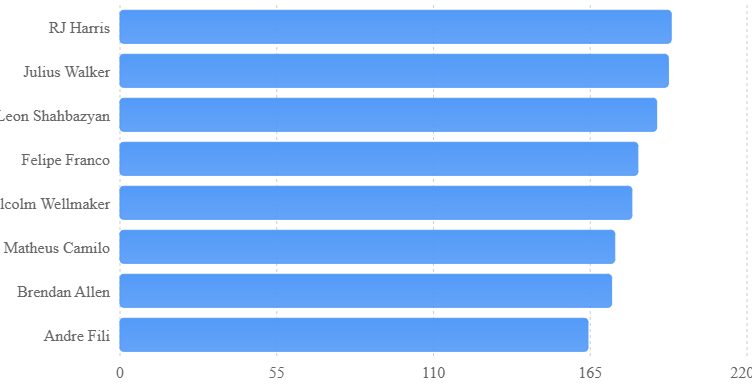
Modeled SACP, not a guaranteed fantasy score.
Solver interpretation: Shahbazyan’s SACP is only 2.6% below Harris, despite costing $400 less and carrying 3.2 percentage points less ownership. That is exactly the type of ceiling preservation we want when seeking separation.
2. Best spend-up fighters
RJ Harris
Highest SACP
$9,100 · 21.0% owned · 193.4 SACP
Harris is the strongest raw ceiling anchor. His combination of projection and upper-tail potential makes him suitable for Single Entry or a tournament build that differentiates elsewhere.
Julius Walker
$9,200 · 23.1% owned · 192.4 SACP
Almost identical ceiling to Harris, but $100 more expensive and 2.1 ownership points higher. Strong spend-up, though Harris wins the direct comparison on salary and leverage.
Leon Shahbazyan
Preferred leverage anchor
$8,700 · 17.8% owned · 188.3 SACP
Shahbazyan is my favorite tournament alternative to the highest-priced fighters. His upper-tail projection is competitive with Harris and Walker, with better salary flexibility and lower ownership.
Felipe Franco
$9,300 · 20.4% owned · 181.7 SACP
The most expensive fighter in the slate. A legitimate ceiling option, but his $9,300 salary creates more opportunity cost than Shahbazyan or Harris. Better suited to differentiated 3-Max constructions.
Malcolm Wellmaker
$8,900 · 20.3% owned · 179.6 SACP
Solid ceiling and a slightly lower salary than the premium favorites. A reasonable secondary anchor, although his leverage profile is less attractive than Shahbazyan’s.
Spend-up ranking for tournaments: Shahbazyan for leverage, Harris for maximum modeled ceiling, Walker for an alternative high-end anchor, followed by Franco and Wellmaker.
3. Right-tail trends: where the slate can be won
The P95 and P99 simulations help us distinguish fighters with ordinary scoring potential from those capable of producing unusually high tournament scores.
| Fighter | P90 | P95 | P99 |
|---|---|---|---|
| RJ Harris | 150.6 | 177.2 | 242.4 |
| Julius Walker | 147.0 | 174.8 | 243.2 |
| Leon Shahbazyan | 140.7 | 168.9 | 236.0 |
| Felipe Franco | 141.0 | 166.1 | 228.9 |
| Malcolm Wellmaker | 141.0 | 165.8 | 225.9 |
| Brendan Allen | 134.9 | 159.2 | 216.6 |
| Matheus Camilo | 133.8 | 158.6 | 216.6 |
| Andre Fili | 130.1 | 152.4 | 207.0 |
These are simulated percentiles, not independently validated probabilities of achieving those scores. MMA has highly discrete outcomes, so the extreme P99 values should be treated as directional upside estimates.
The important finding
Harris and Walker dominate the highest percentile projections, but Shahbazyan maintains nearly the same extreme-tail access at meaningfully lower ownership.
Camilo also deserves special attention. His P99 of 216.6 is comparable to Brendan Allen’s 216.6, yet Camilo is projected at 15.6% ownership versus Allen’s 24.6%.
That is a substantial tournament difference.
4. Finish equity: identifying slate-breaking potential
Finish potential matters enormously in MMA DFS because an early stoppage can combine win bonuses, knockdowns, strikes and other scoring opportunities.
The solver uses betting odds to estimate a finish proxy. These are model-derived indicators, not direct calibrated probabilities of a finish.
| Fighter | Win implied | Finish proxy |
|---|---|---|
| Felipe Franco | 79.8% | 75.5% |
| Julius Walker | 75.3% | 71.7% |
| RJ Harris | 78.3% | 70.2% |
| Leon Shahbazyan | 58.7% | 61.7% |
| Matheus Camilo | 65.8% | 52.8% |
| Malcolm Wellmaker | 69.2% | 50.7% |
| Francisco Prado | 59.7% | 47.6% |
| Niko Price | 45.5% | 41.9% |
Franco has the strongest modeled finish profile, but his salary makes him less efficient than some alternatives. Shahbazyan is especially intriguing because he combines a high finish proxy with a relatively modest implied win probability—an appealing high-variance profile for large tournaments.
Francisco Prado is the value-range standout here. His 47.6% finish proxy is notably higher than those of many fighters priced near him.
5. Best values on the board
The most interesting value plays are not necessarily the cheapest fighters. We want fighters who can deliver meaningful upper-tail scoring without forcing multiple unlikely outcomes elsewhere in the roster.
| Fighter | Salary | RST% | SACP | P99 |
|---|---|---|---|---|
| Alice Pereira | $8,400 | 12.3% | 151.5 | 188.9 |
| Melissa Gatto | $8,300 | 15.2% | 151.1 | 189.3 |
| Francisco Prado | $8,000 | 12.7% | 141.1 | 176.8 |
| Ernesta Kareckaite | $7,900 | 13.0% | 135.6 | 169.3 |
| Christian Leroy Duncan | $7,700 | 16.2% | 131.2 | 164.3 |
| Daria Zhelezniakova | $7,800 | 10.3% | 123.0 | 154.6 |
My preferred values are Alice Pereira, Francisco Prado and Ernesta Kareckaite.
Pereira offers the highest SACP of this group at relatively low ownership. Prado has the strongest finish-oriented appeal in the lower-middle salary tier. Kareckaite provides useful salary relief without sacrificing as much modeled ceiling as the cheapest fighters.
Daria Zhelezniakova is more of a large-field tournament consideration, where her 10.3% ownership becomes an important advantage.
6. Smart pivots and fragile chalk
| Popular option | RST% | Pivot | RST% | Why pivot? |
|---|---|---|---|---|
| Julius Walker | 23.1% | Leon Shahbazyan | 17.8% | Similar elite ceiling, $500 cheaper |
| Brendan Allen | 24.6% | Matheus Camilo | 15.6% | Comparable P99, 9-point ownership discount |
| Lupita Godinez | 20.7% | Alice Pereira | 12.3% | $600 savings, stronger SACP separation profile |
| Kai Kamaka | 23.0% | Francisco Prado | 12.7% | Higher modeled ceiling despite $400 extra salary |
| Melissa Gatto | 15.2% | Alice Pereira | 12.3% | Similar ceiling with slightly better leverage |
The standout fade consideration is Kai Kamaka. At $7,600, he carries 23% projected ownership but only 105.8 SACP. Several fighters costing a few hundred dollars more offer significantly better modeled upper-tail access.
Brendan Allen is another ownership-sensitive decision. His ceiling remains strong, but the gap between his ownership and Camilo’s makes Camilo an attractive tournament substitute.
I would not classify Walker as bad chalk. His raw ceiling supports the ownership. The question is whether Shahbazyan offers a better route to a unique, high-scoring lineup.
7. Salary-adjusted right-tail separation
The solver’s Right-Tail Separation metric highlights ceiling relative to salary and ownership.
| Fighter | Salary | RST% | Separation |
|---|---|---|---|
| Alice Pereira | $8,400 | 12.3% | 50.5 |
| Leon Shahbazyan | $8,700 | 17.8% | 49.2 |
| Daria Zhelezniakova | $7,800 | 10.3% | 48.8 |
| Matheus Camilo | $8,800 | 15.6% | 48.5 |
| Francisco Prado | $8,000 | 12.7% | 48.1 |
| Ernesta Kareckaite | $7,900 | 13.0% | 47.0 |
These are my preferred separation candidates among fighters with meaningful modeled ceiling. The cheapest underdogs can also score highly on leverage ratios simply because their ownership is extremely low; that does not automatically make them good roster choices.
For example, Brendson Ribeiro has a separation score of 55.9 at 2.6% ownership, but his SACP is only 61.4. He is a very speculative large-field play, not a core value.
8. Single Entry vs. 3-Max vs. large-field GPPs
| Strategy | Primary targets | Approach |
|---|---|---|
| Single Entry | Harris, Shahbazyan, Pereira, Prado | Prioritize strong ceiling with selective leverage |
| 3-Max | Harris, Walker, Shahbazyan, Camilo, Franco | Rotate anchors and diversify ownership exposure |
| Large-field GPP | Shahbazyan, Camilo, Pereira, Prado, Zhelezniakova | Pursue high-ceiling, lower-owned combinations |
Before finalizing combinations, we need to respect fight pairings. The source data does not identify opponents, so these are fighter-level recommendations rather than validated six-fighter lineup combinations.
9. Final condensed fighter pool
Primary tournament core
Priority
RJ Harris · Leon Shahbazyan · Matheus Camilo · Alice Pereira · Francisco Prado
Secondary rotation
Julius Walker · Felipe Franco · Malcolm Wellmaker · Ernesta Kareckaite · Melissa Gatto
High-variance separators
Daria Zhelezniakova · Christian Leroy Duncan · Gerald Meerschaert · Brendson Ribeiro
Ownership-sensitive fighters
Brendan Allen · Lupita Godinez · Kai Kamaka
Final Diamond Life slate strategy
My preferred tournament construction is to anchor around one elite raw-ceiling fighter and one high-ceiling leverage fighter, then use the middle salary range to preserve upside without taking unnecessary ownership.
Harris is the premium raw-ceiling option. Shahbazyan is the strongest leverage anchor. Camilo and Pereira offer additional separation, while Prado is particularly interesting because of his finish-oriented upside.
For a smaller-field contest, I would lean toward ceiling certainty and avoid forcing extremely low-owned underdogs. For a massive top-heavy GPP, the ownership discounts on Shahbazyan, Camilo and Pereira become more valuable.
The central lesson of this slate is that we can gain substantial ownership leverage without sacrificing much modeled ceiling. That is where I would concentrate our Diamond Life tournament strategy.


Leave a Reply