There’s a particular kind of slate that shows up a few times a season and quietly scrambles conventional DFS wisdom: the one where the quarterback pool is too good. Not top-heavy, not thin at value — deep, top to bottom, with legitimate tournament-winning upside sitting at nearly every price point. That’s this week’s problem, and it’s a good problem to have, because it means the real skill test isn’t “who’s the best quarterback.” It’s “where do you want your leverage to live.”
The Case for Not Overthinking the Top
Start at the top, because that’s where the field will make its first mistake — either by overpaying for the obvious name or overcorrecting into total avoidance.
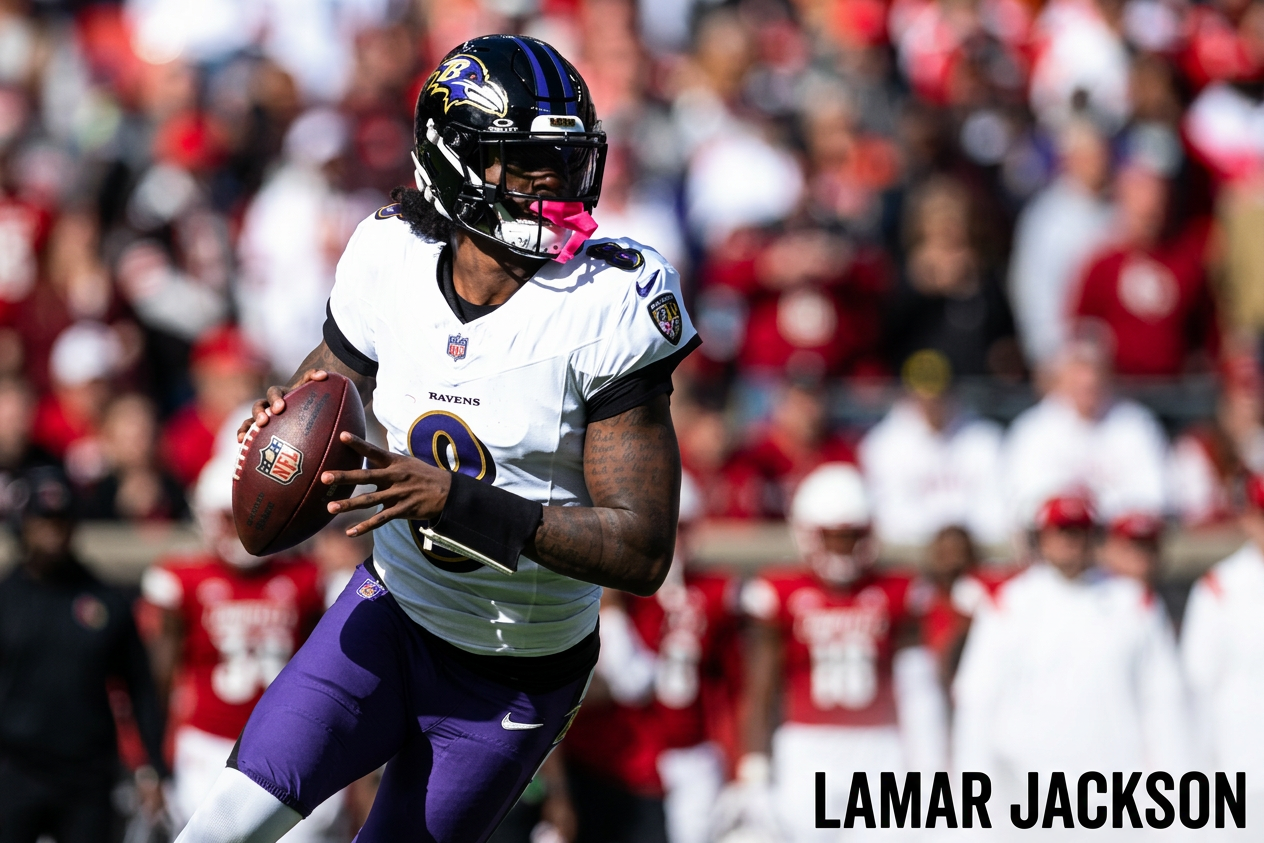
Lamar Jackson at $6,800 is the clean, boring-but-correct pick. He projects to roughly a 30-point median outcome with a ceiling north of 36, and — critically — his ownership sits at a modest 5.7%. That’s the sweet spot: elite equity, moderate cost, field not fully onside. Pair him with Zay Flowers or Mark Andrews, and if you want to get aggressive, Rashod Bateman as a low-owned third wheel.
Josh Allen at $7,000 is the highest-ceiling arm on the board, full stop, and somehow still sub-5% owned. Joe Burrow, meanwhile, isn’t really a QB play so much as an environment play — Cincinnati–Tampa Bay carries a 50.5-point total, and Burrow-Chase is the kind of stack that wins tournaments outright.
The order here — Lamar, then Allen and Burrow roughly co-equal, then Hurts, then Daniels — isn’t gospel, it’s a starting frame. And Jayden Daniels deserves a special mention: 1.4% ownership on a player with a real path to a monster week is exactly the kind of asymmetry tournament players should be hunting for.
The Middle Class Might Be the Best Neighborhood
Here’s the underrated take of the week: the mid-tier quarterbacks might be the sharpest range on the entire slate.
Caleb Williams at $6,300 gives you three separate viable pass-catchers to build around — Burden, Odunze, Loveland — which means you’re not boxed into a single correlation path. Dak Prescott at $6,400 is quietly one of the best pure tournament constructions available; a 25.5-point Dallas implied total with Lamb, Pickens, and Ferguson all in range gives you real flexibility in how you build the stack. And Drake Maye at $6,000 is the leverage special of the group — 2.7% projected ownership against a ceiling that doesn’t apologize for itself.
If you’re building a smaller-entry lineup and want a QB nobody else in your pod is touching, this tier is where you go looking.
Getting Weird: The Value and Punt Plays
Now for the fun part.
Jaxson Dart at $5,600 might be the single most interesting price point on the board. His simulated numbers — a P99 near 33, a ceiling percentile pushing 35 — genuinely rival the $7,000 arms above him. For $1,200–$1,400 less. Dart paired with Malik Nabers is the kind of stack that, if it hits, doesn’t just win you your tournament — it wins it by a lot.
Tyler Shough is the more chaotic version of the same idea. Detroit–New Orleans carries a 49.5-point total with the Saints getting a full touchdown, which sets up exactly the kind of pass-funnel game script that turns a $5,600 quarterback into a GPP-winning piece. Shough plus Chris Olave is pure leverage.
And if you want to go all the way to the other extreme — spend nothing at quarterback, load up everywhere else — Tua Tagovailoa at $4,800 is your floor-with-upside anchor, with Cam Ward as the swing-for-the-fences alternative.
Zoom out, and the six most defensible low-owned stacks on the slate are Burrow, Allen, Dak, Purdy, Maye, and Shough — a group that spans almost the entire salary range, which tells you something about how mispriced this position is relative to the field’s expected ownership.
Where the Savings Should Actually Go
If you do pay up at quarterback, the instinct to claw back salary by punting running back is the wrong one this week. The smarter play is to find your discount at wide receiver and tight end instead.
Quentin Johnston ($4,700) is plugged into a 28-point implied Chargers total and still sits under 5% owned — that’s about as good as salary relief gets. Jalen Coker, Xavier Worthy, Romeo Doubs, and Rashid Shaheed round out a genuinely deep cheap-WR tier, and Devaughn Vele at $3,500 is there if you need to break the bank open completely. At tight end, Harold Fannin ($4,200) is the leverage name to know, while Sam LaPorta remains the safer, more chalky raw play.
For the FLEX specifically: default to wide receiver, not running back. The cheap WR tier simply offers a cleaner path to a boom outcome than the cheap RB tier does this week — though MarShawn Lloyd at $4,800 is a reasonable exception if you need one.
The Chalk You Should Trust, and the Chalk You Shouldn’t
Not all popular plays are created equal, and this is where a lot of tournament rosters quietly go wrong.
Jahmyr Gibbs, projected around 62% owned, is what you’d call justified chalk — his simulated ceiling is the best on the slate, full stop, so being on him isn’t lazy, it’s correct. If you do want off him, CMC and Bijan Robinson are the premium pivots, with Achane as the lower-owned alternative.
Omarion Hampton, on the other hand, is the player to attack. Roughly 23% owned without a ceiling profile that comes close to justifying it — that’s the definition of fragile chalk, and fading him is one of the cleaner leverage decisions on the board.
One more subtle trap: stacking multiple Detroit pieces — Gibbs, Amon-Ra, LaPorta — can feel like correlated brilliance while actually just building the same roster shell half your tournament is building. None of those are bad plays individually. Together, in bulk, they’re just popular. Find your differentiation somewhere else on the roster if you’re leaning heavily into Detroit.
The Environments Worth Building Around
Detroit, Cincinnati, and Dallas project as the three best scoring environments on the slate, with the Rams and 49ers close behind. But for tournament purposes specifically, Cincinnati and Dallas are the more attractive builds — you get access to a genuinely high ceiling without inheriting the ownership baggage that comes with Detroit. Chicago and New Orleans are worth a look too, as lower-owned environments that could pop.
Two Ways to Build This Week
Strip away the noise and this slate really comes down to two coherent paths.
Go premium. Lamar, Allen, or Burrow at quarterback, funded by a discount piece or two at receiver or tight end — Johnston, Worthy, Coker, Fannin, Vele. You’re paying for the safest form of ceiling and trusting your skill-position discounts to still find upside.
Go value. Dart plus Nabers is the headline version of this build, with Shough plus Olave as the higher-variance sibling. You’re sacrificing a little bit of quarterback ceiling for a lot more room to be aggressive everywhere else.
If you’re only entering one lineup, Lamar is the safer anchor and Dart is the pivot worth having ready. If you’re spreading a few entries across a smaller pool, build one of each — a premium build, a mid-tier build around Caleb or Dak, and a value build around Dart — rather than just shuffling the same five players around.
The through-line, whichever path you take: never punt a position just to punt it. Every dollar you save should be buying you a second real shot at a ceiling outcome somewhere else on the roster. That’s the whole game.


Leave a comment