
Diamond Life CFB — Vegas × Dual-Source Solver Analysis
November 19, 2026 | 104-player slate | DraftKings
After reviewing the uploaded slate, the strongest opportunities come from combining Vegas scoring expectations, player opportunity, salary efficiency, and lineup correlation.
My biggest takeaway: Oregon offers the best balanced stacking environment, Toledo offers strong touchdown concentration, and Duke’s Nate Sheppard provides the most attractive premium RB foundation. New Mexico–Wyoming is the most interesting alternative to the obvious high-total offenses.
These are projection-based edges. The 50,000-run Monte Carlo simulation has not been completed, and the file has no RST% column, so actual P95/P99, SACP, XVO, and ownership-adjusted leverage remain unconfirmed.
1. Best ceiling candidates
Ranked by uploaded fantasy-point projections, with role and matchup considerations.
| Player | Salary | FPTS | Why he matters |
|---|---|---|---|
| Evan Medders, QB | $8,200 | 27.26 | Highest projection; starting role needs verification |
| Nate Sheppard, RB | $9,300 | 26.29 | Elite projected workload |
| Kemper Hodges, QB | $8,300 | 24.30 | Strong projection; competing Air Force QB listing |
| CJ Miller, RB | $8,500 | 22.63 | Toledo’s 32.5 implied points |
| Scottre Humphrey, RB | $7,600 | 20.11 | Volume-driven RB ceiling |
| Landon Sims, QB | $7,500 | 20.10 | Strong fantasy projection in a low-total game |
| Dierre Hill, RB | $6,800 | 19.28 | Attractive workload and salary |
| Dakorien Moore, WR | $7,500 | 19.18 | 9.5 projected targets |
Best premium RB: Nate Sheppard. His 26.29 FPTS projection and 21.5 projected touches provide a compelling starting point for single-entry construction.
Best midrange RB: Dierre Hill. He costs $2,500 less than Sheppard while retaining a strong 19.28-point projection.
Best premium WR: Dakorien Moore. His target projection supports a meaningful ceiling if Oregon’s passing offense delivers.
2. Best salary-adjusted values
Value is projected fantasy points divided by salary in thousands.
| Player | Salary | FPTS | Value |
|---|---|---|---|
| Jamari Johnson, WR | $4,700 | 15.62 | 3.32× |
| Dierre Hill, RB | $6,800 | 19.28 | 2.84× |
| Nate Sheppard, RB | $9,300 | 26.29 | 2.83× |
| Kiefer Sibley, RB | $6,200 | 17.07 | 2.75× |
| Landon Sims, QB | $7,500 | 20.10 | 2.68× |
| CJ Miller, RB | $8,500 | 22.63 | 2.66× |
| Scottre Humphrey, RB | $7,600 | 20.11 | 2.65× |
Best salary-adjusted opportunities
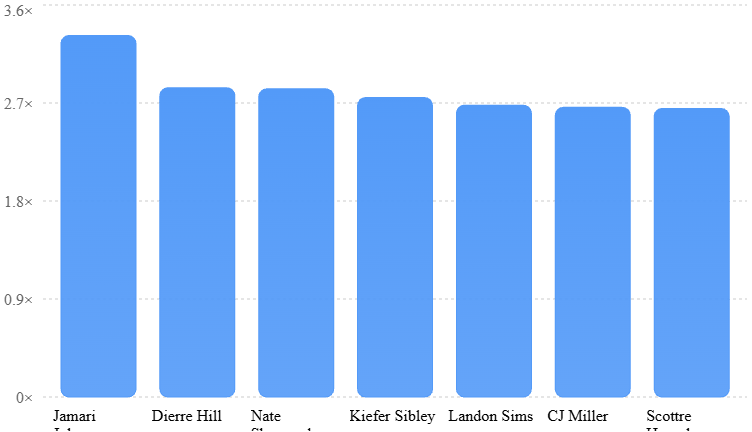
Jamari Johnson stands out because his salary creates room to roster multiple premium players without completely sacrificing projected production.
3. Best sleepers and salary-saving pivots
These are players worth considering for tournament differentiation, although low ownership has not been verified.
| Player | Salary | FPTS | Value | Appeal |
|---|---|---|---|---|
| Jeremiah Hasley, WR | $4,600 | 11.94 | 2.60× | Duke receiving value |
| Bryant Wesco, WR | $5,200 | 13.48 | 2.59× | Clemson passing opportunity |
| T.J. Moore, WR | $4,300 | 10.83 | 2.52× | Inexpensive receiving exposure |
| Chrishon McCray, WR | $4,900 | 12.29 | 2.51× | Michigan State passing option |
| Brandon Tullis | $4,800 | 11.88 | 2.48× | Midrange salary relief |
| Tyler Brown | $4,500 | 10.62 | 2.36× | Lower-cost tournament candidate |
| Messiah Hampton | $3,700 | 8.13 | 2.20× | Deep salary-saving option |
My favorite sleeper is Jeremiah Hasley. His $4,600 salary and 11.94-point projection provide a useful alternative to the more expensive receiving options.
Bryant Wesco is another interesting option because Clemson could face a negative game script against Duke, potentially creating passing opportunities.
4. Best game environments
1. Oregon vs. Michigan State
Best balanced stacking environment
44.5 O/U
Oregon’s 30.5 implied points align with strong projections for Raiola, Hill, Moore, and Johnson. This is my favorite environment for building a passing stack with salary flexibility.
2. Toledo vs. Bowling Green
Best high-total touchdown opportunity
48.5 O/U
Toledo’s 32.5 implied points support Miller, Richter, and Dabbs. The main decision is whether to capture production through the running game or passing correlation.
3. Air Force vs. UTEP
Highest implied scoring, highest validation risk
47.5 O/U
Air Force’s 35 implied points make this a high-priority offense, but Medders and Hodges both carry major QB projections. Confirm the actual starting quarterback before investing heavily.
4. New Mexico vs. Wyoming
Best lower-total alternative
37.5 O/U
Humphrey, Sibley, and Sims have notable projections despite the low total. This is an opportunity to target individual workloads instead of relying on team scoring alone.
5. Duke vs. Clemson
Best individual RB concentration
40.5 O/U
Sheppard’s 26.29-point projection stands out even though Duke has a more modest 27-point implied total.
5. Best correlations and secondary stacks
| Stack or pairing | Strategic advantage |
|---|---|
| Raiola + Dakorien Moore | Premium Oregon passing correlation |
| Raiola + Jamari Johnson | Salary-efficient Oregon passing stack |
| Richter + Adjatay Dabbs | Toledo passing touchdown concentration |
| CJ Miller + opposing BGSU receiver | Alternative game script if Bowling Green keeps pace |
| Nate Sheppard + Bryant Wesco | Duke rushing production paired with Clemson comeback passing |
| Dierre Hill + Michigan State receiver | Oregon lead script paired with opposing passing volume |
The Sheppard + Wesco pairing is especially interesting as a secondary correlation. It offers two different routes to fantasy production: Duke controlling the game through its RB and Clemson generating receiving volume while trailing.
These pairings are scenario-based constructions, not proven positive correlations from a simulation.
6. Interesting tournament advantages
Advantage A — Don’t automatically pay for the highest-total game
Toledo and Air Force have the strongest scoring environments, but Oregon offers more roster-construction flexibility. A lineup built around Oregon’s receiving value can potentially afford a premium RB like Sheppard.
Advantage B — Attack the salary gap
Dierre Hill projects for 19.28 FPTS at $6,800, while CJ Miller projects for 22.63 at $8,500.
Salary saved with Hill
$1,700
Projection sacrificed
3.35 FPTS
That salary difference can meaningfully improve another roster position. Hill is not necessarily the better ceiling play, but he provides a strong opportunity-cost alternative.
Advantage C — Use game-script pivots
If Toledo scores early and controls the game, Miller could benefit more than a full passing stack. If Bowling Green stays competitive, Richter–Dabbs becomes more attractive.
The same principle applies to Oregon: a competitive game benefits passing volume, while a comfortable Oregon lead can favor Hill.
Advantage D — Be selective with expensive chalk
Your adjusted ownership model is:
\[ \text{Own\%}=\min(1.42\times\text{RST\%},80\%) \]
At an original RST% of 30%, adjusted ownership becomes 42.6%. A player at that ownership must deliver substantial ceiling to justify the duplication risk.
Because the actual RST% values are absent, we should not label Sheppard, Miller, or any other player chalk yet.
7. My final priority board
| Category | Selection |
|---|---|
| Best premium RB | Nate Sheppard |
| Best midrange RB | Dierre Hill |
| Best premium WR | Dakorien Moore |
| Best WR value | Jamari Johnson |
| Best alternative QB | Landon Sims |
| Best QB stack candidate | Dylan Raiola + Oregon WR |
| Best high-total offense | Toledo |
| Best balanced offense | Oregon |
| Best lower-total opportunity | New Mexico–Wyoming |
| Best secondary correlation | Sheppard + Wesco |
| Biggest pre-lock verification | Air Force QB situation |
8. How I would attack single-entry
My preferred construction starts with an Oregon passing correlation, then uses a premium high-workload RB such as Sheppard or Miller. Jamari Johnson offers the salary relief needed to make this structure viable.
For a contrasting tournament build, I’d consider a Toledo rushing-focused lineup with CJ Miller and a lower-total-game piece such as Sims or Sibley. This provides a different route to first place if Oregon’s passing production disappoints.
The critical distinction is that these are recommended construction directions, not validated optimal lineups. We still need roster-cap validation, confirmed starters, and ownership data before locking in a single-entry lineup.
Bottom line: Oregon is my favorite balanced tournament environment, Sheppard is my favorite premium RB, Hill and Jamari Johnson are the most useful salary-adjusted pieces, and New Mexico–Wyoming offers the most interesting alternative to the obvious scoring environments. The biggest potential edge will come from confirming which of those opportunities remains under-owned after your 1.42× correction.


Leave a Reply