
Diamond Life CBB DFS — Full Slate Edge Report
November 13, 2026 | Vegas + Monte Carlo + SACP + Right-Tail Separation
The biggest takeaway from our CBB analysis is that the best tournament opportunities aren’t necessarily in the highest-scoring games. They’re where individual ceiling, salary efficiency, and the Vegas environment align—and where ownership may not fully reflect that upside.
Our solver identifies three particularly attractive strategies: building around Amari Allen’s exceptional ceiling at a mid-premium salary, targeting Mississippi State–Xavier for correlated scoring upside, and using lower-total games to find potential tournament pivots.
1. Best overall ceiling plays
RANKED BY SIMULATED SACP
| Player | Salary | SACP | P99 | Assessment |
|---|---|---|---|---|
| Thijs De Ridder (UVA) | $10,200 | 66.1 | 75.5 | Highest raw ceiling |
| Amari Allen (ALA) | $7,500 | 65.9 | 75.4 | Best ceiling per dollar |
| Baye Ndongo (PITT) | $9,700 | 58.4 | 66.5 | Premium alternative |
| Ivan Kharchenkov (ARI) | $9,200 | 58.3 | 66.3 | Strong game environment |
| Josh Hubbard (MISSST) | $8,300 | 56.1 | 63.4 | High-total upside |
| Silas Demary (UCONN) | $9,400 | 55.9 | 63.7 | Lower-total pivot |
| Tahaad Pettiford (AUB) | $10,100 | 53.0 | 60.9 | Expensive tournament option |
| Motiejus Krivas (ARI) | $9,400 | 53.0 | 60.1 | Alternative Arizona ceiling |
The biggest edge is Amari Allen. His SACP is almost identical to De Ridder’s, but he costs $2,700 less. That difference can materially improve the ceiling of the rest of a lineup.
De Ridder still deserves consideration when salary is available, particularly if his ownership is lower than that of similarly priced stars.
2. Best values and salary savers
| Player | Salary | SACP | Why he matters |
|---|---|---|---|
| Sayon Keita (UNC) | $4,400 | 43.2 | Elite salary-adjusted upside |
| King Grace (MISSST) | $4,400 | 41.5 | High-total value |
| Ace Buckner (CLEM) | $5,300 | 42.2 | Lower-total pivot |
| D.J. Wagner (MD) | $3,900 | 35.3 | Affordable ceiling |
| Gabriel Pozzato (XAV) | $3,600 | 33.0 | Salary flexibility |
| Freddie Dilione (UGA) | $3,800 | 31.6 | Cheap high-total exposure |
| Neo Avdalas (UNC) | $4,900 | 37.4 | Secondary UNC value |
Keita and Grace are the two strongest value candidates. Both have SACP above 40 at $4,400, making it possible to roster more premium players without sacrificing as much simulated upside.
Pozzato and Wagner are interesting when constructing stars-and-scrubs lineups, although their roles and minutes need verification.
3. Best game environments
Vegas game totals
Six highest-total games from the slate
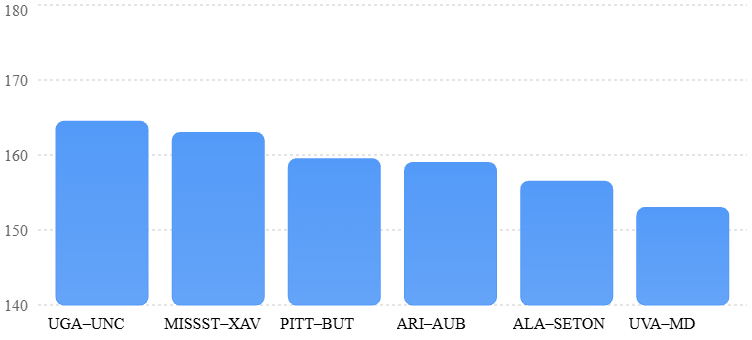
Mississippi State–Xavier — best balanced tournament environment. Hubbard, Milicevic, Washington, and Grace provide several salary combinations with strong simulated upside. This is my preferred game for selectively pairing players from both teams.
Georgia–UNC — best value environment. The slate’s highest total supports the appeal of Keita, Avdalas, Dilione, and Terrence Brown. However, the total alone doesn’t justify rostering all of them together.
Alabama–Seton Hall — best individual ceiling opportunity. Allen stands out dramatically, but Alabama’s 17.5-point favorite status creates meaningful blowout risk.
Arizona–Auburn — best premium-ceiling environment. Kharchenkov, Krivas, and Pettiford offer upside, although their salaries make roster construction more restrictive.
Virginia–Maryland — best lower-total premium pivot. De Ridder and Mallory demonstrate that strong individual outcomes can emerge outside the highest-total games.
4. Five sleepers worth targeting
01
Ace Buckner
$5,300
Clemson
42.2 SACP in a 147-point game. A strong potential pivot away from higher-total value chalk.
02
Chance Mallory
$7,300
Virginia
52.8 SACP despite a 153-point game total. Strong midrange tournament ceiling.
03
Braylon Mullins
$7,700
UConn
46.1 SACP in a 147-point matchup. An alternative to players in more attractive Vegas environments.
04
Gabriel Pozzato
$3,600
Xavier
33.0 SACP and access to a 163-point game. A useful salary-saving option.
05
Vince Iwuchukwu
$7,600
Clemson
47.7 SACP in a lower-total game. A candidate for differentiated tournament builds.
These are sleeper candidates based on ceiling, salary, and game context. They are not confirmed low-owned plays because the uploaded data does not provide authoritative ownership projections.
5. The most useful strategic advantages
Advantage 1 — Exploit the Allen–De Ridder salary gap. Allen offers virtually the same simulated P99 for $2,700 less. Unless their ownership or roles materially change the comparison, Allen is the more efficient tournament starting point.
Advantage 2 — Use Mississippi State–Xavier for selective game correlation. Hubbard and Milicevic offer access to both sides of a high-total matchup. Correlation is most valuable when both players’ production can benefit from a competitive, fast-paced game.
Advantage 3 — Don’t confuse game popularity with player value. Georgia–UNC has the highest total, but Keita may provide more useful salary-adjusted upside than more expensive options in the same game.
Advantage 4 — Attack lower-total games through individual ceiling. Mallory, Buckner, Demary, and De Ridder offer alternatives to total-driven roster construction. These become especially attractive if ownership confirms the field is overlooking them.
Advantage 5 — Build around different game scripts. Rather than forcing every lineup into the same high-total games, distribute tournament exposure across Alabama ceiling outcomes, Mississippi State–Xavier shootouts, and lower-total individual breakouts.
6. My final tournament priority board
BEST OVERALL PLAY
Amari Allen
$7,500 · Alabama
65.9
SACP
Best premium pivot
Thijs De Ridder
Best high-total anchor
Josh Hubbard
Best value
Sayon Keita
Best secondary value
King Grace
Best midrange pivot
Chance Mallory
Best sleeper candidate
Ace Buckner
7. Single-entry versus MME
For single-entry, my preferred starting core is Amari Allen, Josh Hubbard, and Sayon Keita. This combines a high-ceiling anchor, exposure to a strong game environment, and efficient salary relief. I would then evaluate Buckner, Grace, or Milicevic based on the remaining salary and roster positions.
For MME, I would build distinct groups around Alabama’s individual ceiling, Mississippi State–Xavier’s scoring environment, Arizona–Auburn’s premium upside, and lower-total pivots. The objective is to capture different paths to the slate’s highest scores without overconcentrating on one game script.
Final verdict
The five strongest actionable angles are Allen’s ceiling-per-dollar advantage, Hubbard’s high-total upside, Keita’s value, Mississippi State–Xavier’s multiple viable ceiling plays, and lower-total pivots such as Mallory and Buckner.
The remaining step before treating these as confirmed leverage plays is to compare actual projected ownership, injury updates, and starting roles against the solver rankings. The SACP and P99 figures are model estimates, not guaranteed outcomes, and the current dual-source comparison is not fully independent of Vegas inputs.
That distinction matters: the strongest tournament edge is not simply finding a high ceiling. It is finding a high ceiling that the field has genuinely underpriced.


Leave a Reply