Diamond Life CFB DFS — Complete Slate Edge Report
November 7, 2026 | FanDuel | Single Entry, 3-Max & MME
Our strongest opportunities come from combining historical fantasy production, salary efficiency, game environments, lineup correlation, and your existing exposure.
The central tournament strategy: Prioritize high-ceiling quarterbacks, identify concentrated scoring environments, and diversify away from overly repetitive lineup constructions.
The rankings below use the historical player data and portfolio analysis from our earlier work. Current Vegas lines, projected field ownership, and validated Monte Carlo P95/P99 outcomes have not been established, so the recommendations remain provisional.
1. Best ceiling plays
Sam Leavitt — QB
Premium anchor
29.89 FPPG
$11,500 • 2.60 FPPG/$1K
A leading quarterback anchor candidate. His premium salary requires a strong game script, but his historical production supports further ceiling investigation.
Conner Weigman — QB
28.51 FPPG
$11,300 • 2.52 FPPG/$1K
Strong candidate for Houston-centered constructions. Already appears in 66.7% of your entries, making portfolio concentration an important consideration.
Nate Sheppard — RB
31.75 FPPG
$12,400 • 2.56 FPPG/$1K
The highest historical FPPG among the players highlighted in our analysis. A premium RB candidate if current workload and health support his historical scoring.
Darian Mensah — QB
27.36 FPPG
$11,000 • 2.49 FPPG/$1K
Alternative premium quarterback who could improve lineup differentiation if his forward ceiling is comparable to more popular options.
Jeremiah Smith — WR
27.05 FPPG
$11,400 • 2.37 FPPG/$1K
High-production receiver candidate. Worth evaluating for premium WR constructions, especially if quarterback salary savings open sufficient cap space.
Additional quarterback alternatives: Trinidad Chambliss ($10,700, 26.18 FPPG) and Devon Dampier ($10,500, 25.68 FPPG). Both offer historically productive alternatives to the highest-priced quarterbacks.
2. Best value plays and sleepers
| Player | Salary | FPPG/$1K | Assessment |
|---|---|---|---|
| Ivan Carreon, WR | $6,800 | 3.43 | High-risk upside |
| Donovan Olugbode, WR | $7,400 | 2.12 | Value candidate |
| Dakorien Moore, WR | $7,300 | 1.87 | Alternative WR |
| Keenan Jackson, WR | $7,200 | 1.91 | Salary relief |
| Trelain Maddox, RB | $6,600 | 2.00 | RB value |
| Evan Stewart, WR | $6,800 | 1.90 | WR sleeper |
FPPG/$1K is historical average fantasy points divided by salary in thousands. It is not a forward-looking value projection.
The most interesting salary-saving candidate is Trelain Maddox, because affordable running backs can unlock premium quarterback and receiver combinations.
Carreon has the strongest historical salary efficiency, but only one recorded game. I would treat him as a speculative MME candidate rather than a dependable single-entry value.
Olugbode offers a more substantial six-game historical sample and deserves consideration as a salary-conscious WR option.
3. Best game environments
Historical fantasy-production environments
Sum of the six highest player FPPG averages in each game
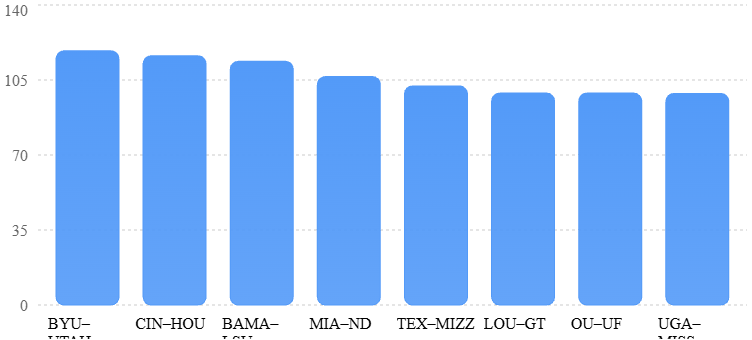
BYU–Utah is our first environment to investigate. Its historical fantasy production leads the slate, and the combination of Dampier, Parker, and Bachmeier offers multiple possible correlation paths. A close Vegas spread would strengthen the case for game stacking.
Cincinnati–Houston is especially attractive for quarterback-led roster construction because Weigman brings a strong historical baseline. A full game stack should depend on confirmation that both teams have meaningful scoring expectations.
Alabama–LSU offers another premium quarterback environment through Leavitt. The key question is whether the game remains competitive enough to sustain four quarters of offensive production.
Miami–Notre Dame and Texas–Missouri are secondary environments to evaluate for lower-owned combinations.
The most interesting potential leverage games are Louisville–Georgia Tech, Oklahoma–Florida, and Georgia–Ole Miss. If current Vegas lines forecast more scoring than their historical rankings imply, these games could move substantially higher in our tournament priorities.
4. Five tournament edges that matter most
Edge 1 — Quarterback opportunity cost
Compare Leavitt, Weigman, Mensah, Chambliss, and Dampier by the total lineup ceiling each makes possible, not quarterback FPPG alone. A slightly cheaper quarterback can create a better overall tournament construction.
Edge 2 — Concentrated offensive production
Prefer games where fantasy production flows through identifiable quarterbacks and a small group of playmakers. Correlated upper-tail outcomes are more valuable than a high team total spread across many players.
Edge 3 — Vegas-versus-solver disagreement
A lower-ranked historical game that receives strong independent Vegas support deserves immediate investigation. This is where hidden game-stack opportunities may emerge.
Edge 4 — Portfolio diversification
Bo Jackson appears in 75% of your uploaded entries, while Weigman appears in 66.7% and Leavitt in 50%. These concentrations should be stress-tested against alternative game scripts and failure scenarios.
Edge 5 — Availability and role uncertainty
Injury indicators and unusual historical samples create significant projection risk. Verify the roles of flagged players and investigate Nicco Marchiol’s 33.3% portfolio exposure against his very low historical FPPG before lock.
5. My condensed player pool
| Role | Players |
|---|---|
| Premium QB candidates | Leavitt, Weigman, Mensah |
| QB alternatives | Chambliss, Dampier |
| Premium RB | Sheppard |
| Premium WR | Jeremiah Smith |
| Value WR candidates | Olugbode, Moore, Jackson |
| Value RB candidate | Maddox |
| Speculative sleepers | Carreon, Stewart |
These are research and lineup-construction candidates, not confirmed optimal plays or ownership leverage rankings.
6. Recommended construction by contest
| Contest | Preferred approach |
|---|---|
| Single Entry | One strong, confirmed game environment with a reliable QB anchor |
| 3-Max | Three differentiated QB/game-script constructions |
| MME | Multiple correlated environments with controlled player overlap |
| Large-field GPP | Favor upper-tail correlation and ownership-adjusted separation over median projection alone |
For your current 36-entry portfolio, the biggest practical improvement may come from changing lineup combinations rather than simply adding more individual players.
For example, if two lineups share the same quarterback, running backs, and primary receivers, they are effectively making nearly the same bet. A different quarterback/game stack can provide more meaningful outcome diversification.
7. Final Diamond Life priority board
Five highest-priority investigations before lock
- BYU–Utah: Determine whether its historical production translates into a strong projected game environment.
- Cincinnati–Houston: Evaluate Weigman’s ceiling and the viability of correlated Houston builds.
- Leavitt versus alternative QBs: Compare the lineup-wide opportunity cost of each premium quarterback.
- Maddox and Olugbode: Verify whether their current roles make them legitimate salary-saving tournament plays.
- Louisville–GT and Oklahoma–Florida: Look for positive Vegas confirmation and overlooked scoring concentration.
Final takeaway
Our most useful conclusions are that quarterback selection is central to this slate, BYU–Utah and Cincinnati–Houston deserve immediate game-environment attention, and your existing entries have meaningful concentration risk.
The potentially biggest hidden advantage is a secondary game environment that Vegas likes, the forward-looking solver independently projects for ceiling, and the field has not fully embraced.
We have identified where to look, but not yet proven that ownership inefficiency. To turn this into a true Diamond Life tournament-winning edge report, we still need current Vegas lines, forward projections, and field ownership so that P95/P99, SACP, XVO, and Tail Leverage can be calculated and validated.


Leave a Reply