Diamond Life CFB DFS Solver — Complete Slate Edge Report
November 6, 2026 | DraftKings CFB | Vegas + SACP + Right-Tail Ceiling + Tournament Strategy
The strongest conclusion from our CFB analysis is that the best fantasy ceilings are not necessarily concentrated in the highest-total games. Our solver identifies several opportunities where individual upside exceeds what a Vegas-only approach might suggest.
For this slate, I would concentrate on three offensive environments, target the midrange ceiling plays aggressively, and use lower-total games selectively for tournament differentiation.
1. Top 10 overall ceiling plays
Ranked by modeled Solver-Adjusted Ceiling Projection (SACP).
| Rank | Player | Salary | SACP | P99 |
|---|---|---|---|---|
| 1 | Jordan Dwyer, TCU | $6,600 | 53.88 | 75.62 |
| 2 | Isaiah Mizell, ARI | $7,000 | 49.45 | 68.67 |
| 3 | Collin Dixon, ILL | $7,900 | 47.15 | 65.22 |
| 4 | TJ Engleman, ECU | $6,800 | 43.99 | 56.97 |
| 5 | Kevin Jennings, SMU | $8,700 | 43.61 | 53.56 |
| 6 | Anthony Colandrea, NEB | $8,100 | 41.86 | 51.47 |
| 7 | Kendrick Raphael, SMU | $7,800 | 40.56 | 51.23 |
| 8 | Kwazi Gilmer, NEB | $6,200 | 38.31 | 52.99 |
| 9 | Jacory Barney, NEB | $5,500 | 37.26 | 51.60 |
| 10 | Que’Sean Brown, VATECH | $6,000 | 36.79 | 50.98 |
What stands out
Jordan Dwyer is the strongest modeled ceiling-per-dollar candidate. His 53.88 SACP at $6,600 gives him 8.16 SACP per $1,000, significantly above the other highlighted options.
Isaiah Mizell is the second major ceiling target. His $7,000 salary and 68.67 P99 create a potentially valuable alternative to paying for premium quarterbacks and receivers.
Collin Dixon is another important tournament consideration, especially for builds targeting Nebraska–Illinois.
These are modeled upper-tail estimates, not guaranteed outcomes. The current distribution model has not been calibrated through the full correlated game-state simulation.
2. Best value plays
| Player | Salary | SACP | SACP/$1K |
|---|---|---|---|
| Jordan Dwyer | $6,600 | 53.88 | 8.16 |
| Isaiah Mizell | $7,000 | 49.45 | 7.06 |
| Landon Sides | $4,200 | 29.02 | 6.91 |
| Jacory Barney | $5,500 | 37.26 | 6.77 |
| Brandon Phelps | $3,600 | 23.52 | 6.53 |
| Luke Lindenmeyer | $3,900 | 25.02 | 6.42 |
| Bryson Rodgers | $4,500 | 27.19 | 6.04 |
Salary-adjusted ceiling comparison
SACP per $1K
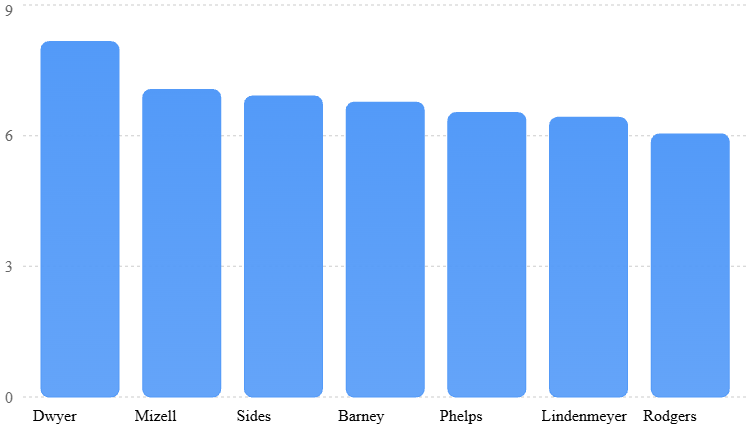
Best midrange value: Jacory Barney. His salary makes it easier to fit premium quarterback production without sacrificing too much modeled ceiling.
Best low-cost value: Landon Sides. At $4,200, his 29.02 SACP is an attractive salary-relief option.
Best punts: Brandon Phelps and Luke Lindenmeyer, subject to role and playing-time verification.
3. Best quarterbacks
| Priority | QB | Salary | SACP | Strategic use |
|---|---|---|---|---|
| 1 | Kevin Jennings | $8,700 | 43.61 | Premium stack anchor |
| 2 | Anthony Colandrea | $8,100 | 41.86 | Tournament anchor |
| 3 | Noah Fifita | $8,500 | 35.86 | Conditional ownership pivot |
Jennings has the strongest quarterback ceiling and plays in the highest-total highlighted game.
However, Colandrea saves $600 while sacrificing only 1.75 modeled SACP points. That is a meaningful opportunity-cost comparison.
For single-entry, I slightly prefer Jennings when his stack fits comfortably. For larger-field tournaments, Colandrea becomes increasingly interesting if the field overconcentrates on SMU.
Fifita needs an ownership discount or another meaningful lineup advantage to overcome his lower modeled ceiling.
4. Best game environments
56.5
Game total
SMU vs. Virginia Tech
Best conventional stack
Jennings, Raphael, and Brown give this matchup several paths to meaningful fantasy production. SMU’s 31-point implied total reinforces the opportunity.
50.5
Game total
Nebraska vs. Illinois
Best diversified environment
Colandrea, Dixon, Gilmer, and Barney give us several salary levels and modeled right-tail outcomes. One of my preferred environments for 3-Max exposure.
46.5
Game total
TCU vs. Arizona
Best ceiling-versus-total divergence
Dwyer and Mizell rank first and second in modeled SACP despite the lower total. This is the most interesting individual-ceiling opportunity to investigate.
39.0
Game total
ECU vs. USF
Selective contrarian
Engleman and Sides have appealing individual metrics, but the scoring environment does not justify an aggressive full-game stack.
5. Five potential sleepers
These are players whose salary, ceiling, or game context makes them worth monitoring for low-ownership opportunities. Actual ownership has not been confirmed.
| Player | Why they matter | Preferred use |
|---|---|---|
| Kwazi Gilmer | 52.99 P99 at $6,200 | Midrange ceiling pivot |
| Que’Sean Brown | 50.98 P99 in a 56.5-total game | SMU stack bring-back |
| Landon Sides | 6.91 SACP/$1K | Contrarian salary relief |
| Brandon Phelps | $3,600 with 23.52 SACP | Punt with upside |
| Luke Reynolds | 35.04 SACP at $5,900 | Midrange tournament alternative |
My favorite potential sleeper is Que’Sean Brown, because he combines a favorable scoring environment with a relatively affordable salary and the ability to complement SMU-focused builds.
Gilmer is the other standout. His modeled upper tail is competitive with more expensive players.
6. Three tournament construction concepts
Build A — High-total attack
SE candidate
Kevin Jennings + correlated SMU teammate + Que’Sean Brown
Attack SMU–Virginia Tech’s scoring environment while maintaining a bring-back that benefits if Virginia Tech keeps pace. Use value elsewhere to offset the stack’s cost.
Build B — Balanced ceiling
3-Max candidate
Anthony Colandrea + Nebraska correlation + Collin Dixon
Capture Nebraska–Illinois upside while preserving salary flexibility. This construction becomes more appealing if SMU attracts substantially higher ownership.
Build C — Individual ceiling attack
Large-field GPP
Jordan Dwyer + Isaiah Mizell + complementary QB stack
Emphasize the slate’s leading modeled skill-player ceilings while obtaining quarterback correlation elsewhere. Verify positional roles and lineup compatibility before committing.
These are lineup frameworks, not salary-validated complete lineups.
7. The biggest strategic edges
Edge 1 — Do not overpay for Vegas chalk
Jennings is the highest-ceiling quarterback, but Colandrea offers nearly comparable modeled upside for $600 less. The correct decision depends on what those savings unlock at other positions.
Edge 2 — Midrange players may decide this slate
Barney, Gilmer, Brown, Dwyer, and Mizell occupy an attractive salary range where modeled ceilings remain substantial. These players can help create lineups with strong total upside without forcing multiple expensive stars.
Edge 3 — Use moderate-total games for individual ceiling
TCU–Arizona is the clearest example. Its 46.5 total does not rank first, but its top two players lead our SACP board.
That makes it an important alternative to building exclusively around SMU.
Edge 4 — Avoid confusing low totals with automatic fades
Engleman and Sides are legitimate individual-play candidates despite ECU–USF’s 39-point total. The question is whether their opportunity concentration can overcome the less favorable environment.
Edge 5 — Correlation matters more than collecting high SACP scores
The best tournament lineup is not necessarily the lineup containing the six highest individual ceilings. A correlated QB–receiver combination can produce a much stronger joint outcome when a game exceeds expectations.
Edge 6 — Ownership determines whether the advantage is real
The biggest unresolved question is whether Dwyer, Mizell, Barney, and the other highlighted plays will actually be underowned.
We should not assign precise leverage rankings until RST% or another reliable ownership source is available.
8. Final Diamond Life priority board
| Category | Preferred plays |
|---|---|
| Best overall modeled ceiling | Jordan Dwyer |
| Second ceiling anchor | Isaiah Mizell |
| Premium quarterback | Kevin Jennings |
| QB tournament alternative | Anthony Colandrea |
| Best midrange value | Jacory Barney |
| Best salary saver | Landon Sides |
| Best potential bring-back | Que’Sean Brown |
| Best midrange sleeper | Kwazi Gilmer |
| Best conventional game stack | SMU–Virginia Tech |
| Best diversified game environment | Nebraska–Illinois |
| Best ceiling-versus-Vegas divergence | TCU–Arizona |
| Best selective contrarian environment | ECU–USF |
Final slate verdict
For single-entry, my preliminary preference is a Jennings or Colandrea quarterback foundation, paired with high-ceiling midrange players and at least one carefully selected correlation.
For 3-Max, I would diversify across SMU–Virginia Tech, Nebraska–Illinois, and a build emphasizing the exceptional individual ceilings from TCU–Arizona.
For large-field MME, I would pay particular attention to Dwyer, Mizell, Gilmer, Brown, and Sides as potential separation plays, but only increase exposure aggressively if ownership projections support the leverage thesis.
The biggest actionable discovery: We do not need the highest-total game to produce the slate’s best fantasy play. The strongest potential edge is combining a Vegas-supported quarterback environment with individually explosive, salary-efficient players from games the field may prioritize less.
All rankings remain conditional on player availability, lineup roles, and ownership. The current solver’s modeled tail distributions are useful for identifying candidates, but should not be treated as fully validated 50,000-game correlated simulation results.


Leave a Reply