Diamond Life Tennis DFS Solver — Full Slate Edge Report
November 5, 2026 | DraftKings | Single-Entry, 3-Max and MME Strategy
The biggest takeaway
This slate is about exploiting expensive favorites whose projected fantasy production does not justify their salaries.
The Diamond Life Tennis Solver identifies three particularly interesting advantages:
- Rinky Hijikata offers the best combination of raw ceiling and salary efficiency. His modeled SACP of 75.7 rivals the most expensive players on the slate.
- Quentin Halys and Arthur Rinderknech project better than their substantially more expensive opponents. These are especially interesting tournament situations because they create salary savings without necessarily sacrificing upside.
- Matteo Berrettini is the slate’s most aggressive value opportunity. At $4,600, he carries a 34.19-point baseline projection and a modeled 62.1 SACP.
These findings are based on the uploaded projections and modeled distributions. Ownership, betting odds, and surface-specific statistics are not available, so projected leverage should not be confused with confirmed low ownership.
1. Best overall ceiling plays
| Rank | Player | Salary | SACP | P99 | Role |
|---|---|---|---|---|---|
| 1 | Rinky Hijikata | $7,400 | 75.7 | 88.4 | Primary anchor |
| 2 | Sorana Cirstea | $9,900 | 75.0 | 87.1 | Premium ceiling |
| 3 | Quentin Halys | $5,800 | 63.6 | 74.6 | Value ceiling |
| 4 | Matteo Berrettini | $4,600 | 62.1 | 72.7 | Salary breaker |
| 5 | Alexandra Eala | $8,500 | 61.6 | 72.1 | Alternative anchor |
| 6 | Tomas Martin Etcheverry | $7,900 | 61.2 | 71.6 | Tournament pivot |
| 7 | Casper Ruud | $8,800 | 48.9 | 57.0 | Secondary option |
SACP = 55% P95 + 25% P90 + 20% P99. These are model-generated tail estimates, not guarantees.
Hijikata versus Cirstea is the most interesting spend-up decision. Hijikata costs $2,500 less while carrying a slightly higher modeled ceiling. That makes Hijikata the superior salary-adjusted play, although Cirstea remains attractive when prioritizing raw upside.
Halys and Berrettini are especially valuable because they offer upper-tail access at salaries usually associated with much weaker fantasy projections.
2. Best value plays and salary breakers
Projected fantasy points per $1,000 salary
Higher values indicate stronger baseline salary efficiency.
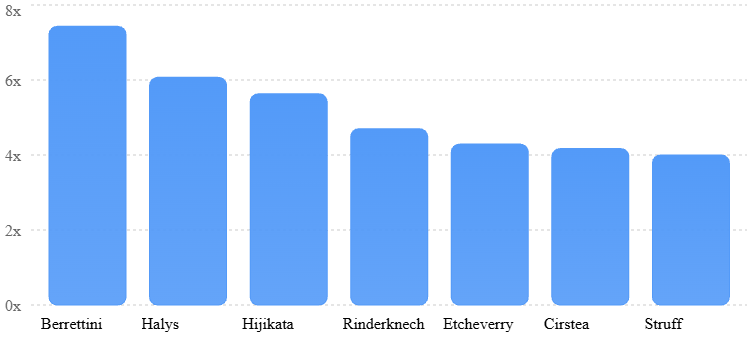
Berrettini is the top salary-adjusted play. His modeled P99 of 72.7 gives him 15.80 upper-tail fantasy points per $1,000 of salary, the best figure on the slate. His historical win rate in the dataset is also 65.3%, although that is not a current-match win probability.
Halys is my favorite verified-matchup value. He offers a 63.6 SACP at $5,800 and projects better than his opponent, Tommy Paul.
Rinderknech is a secondary salary saver. His $5,600 salary and 47.9 SACP are attractive relative to Shelton’s $9,500 salary and 37.0 SACP.
The major strategic benefit is flexibility. Savings from Berrettini or Halys can support higher-ceiling roster spots without requiring multiple expensive favorites.
3. Best sleepers and tournament pivots
Arthur Rinderknech — $5,600
Top sleeper candidate
His opponent, Ben Shelton, carries the slate’s lowest baseline projection at 16.67. Rinderknech has a 56.3 modeled P99 and offers a compelling cheaper-side tournament angle.
XVO proxy
66.4
P99: 56.3
Jan-Lennard Struff — $6,400
A strong salary pivot from Casper Ruud. Struff projects for 25.60 points versus Ruud’s 27.01, but costs $2,400 less. His 54.3 P99 makes him a reasonable tournament alternative.
XVO proxy
63.8
P99: 54.3
Tomas Martin Etcheverry — $7,900
The direct pivot from Hijikata. His 61.2 SACP is respectable, but his appeal depends on whether Hijikata attracts disproportionate ownership. An Etcheverry victory would undermine a popular Hijikata construction.
XVO proxy
74.7
P99: 71.6
Alexandra Eala — $8,500
A secondary high-ceiling option with a 61.6 SACP and 72.1 P99. She can serve as an alternative to more expensive Cirstea constructions, although her salary efficiency is less compelling than Hijikata’s.
XVO proxy
74.4
P99: 72.1
These are potential sleepers and pivots. Actual ownership projections are needed before calling any of them genuinely contrarian.
4. Best match environments
Unlike NBA or NFL DFS, tennis match environments should be evaluated through serve dominance, break opportunities, straight-set probability, match length, and the scoring relationship between opponents.
The current model supports matchup-based salary comparisons, but it does not establish which matches will produce the most aces, breaks, or tiebreaks.
| Matchup | Preferred side | Primary edge |
|---|---|---|
| Halys vs. Paul | Halys | +10.65 projected FPTS, $3,600 cheaper |
| Rinderknech vs. Shelton | Rinderknech | +9.65 projected FPTS, $3,900 cheaper |
| Hijikata vs. Etcheverry | Hijikata | +7.82 projected FPTS, $500 cheaper |
| Struff vs. Ruud | Struff for value | Saves $2,400 for only 1.41 fewer projected points |
How to attack these environments
The Halys–Paul and Rinderknech–Shelton matches offer the most dramatic projection-versus-salary discrepancies.
Hijikata–Etcheverry is the strongest modeled ceiling environment among the fully represented opposing pairs. However, their outcomes are negatively related, so I would generally use them as alternatives rather than stacking both.
Struff–Ruud is primarily a roster-construction opportunity rather than a standout raw-ceiling environment.
5. Right-tail MME separation
The strongest upper-tail salary efficiency comes from comparing P99 against salary.
| Rank | Player | P99 per $1K |
|---|---|---|
| 1 | Matteo Berrettini | 15.80 |
| 2 | Quentin Halys | 12.86 |
| 3 | Rinky Hijikata | 11.95 |
| 4 | Arthur Rinderknech | 10.05 |
| 5 | Tomas Martin Etcheverry | 9.06 |
| 6 | Sorana Cirstea | 8.80 |
| 7 | Alexandra Eala | 8.48 |
This produces an interesting tournament insight: the strongest salary-adjusted upper tails are concentrated below $8,000.
A lineup strategy that automatically prioritizes multiple $9,000-plus players may sacrifice substantial ceiling efficiency.
However, the workbook’s simulation uses a projection-centered, nonnegative normal distribution with standard deviation set to approximately 48% of each projection. This means P99 and SACP largely inherit the baseline projection rankings. They are useful scenario estimates, but not independent evidence that a player has superior serve-based or straight-set upside.
6. Chalk fades and opportunity cost
The following players are the most questionable expensive investments based on the uploaded projections.
| Player | Salary | Projection | XVO |
|---|---|---|---|
| Ben Shelton | $9,500 | 16.67 | 53.4 |
| Tommy Paul | $9,400 | 24.58 | 59.9 |
| Lorenzo Musetti | $9,300 | 25.94 | 61.8 |
| Casper Ruud | $8,800 | 27.01 | 63.6 |
Shelton stands out as the clearest projection-based fade. He costs $3,900 more than Rinderknech while projecting 9.65 points lower.
Paul is similarly difficult to justify against Halys on the supplied numbers.
Musetti’s 2.79x baseline value is weak, and his opponent is missing from the dataset. That makes him a lower-priority expensive option until the matchup can be verified.
Ruud is less extreme, but Struff offers almost the same projected output at a substantial discount.
These are not automatic fades regardless of ownership. Extremely low ownership or meaningful new match information could change their tournament value.
7. Single-entry versus MME strategy
Single-entry
Prioritize Hijikata as the primary ceiling anchor, Halys as the strongest verified-matchup value, and Berrettini as a conditional salary breaker once his opponent and status are confirmed.
Limit exposure to weakly projected expensive favorites. Favor players who combine strong raw projection with salary efficiency.
3-Max
Consider separate constructions centered on Hijikata, Cirstea, and an Etcheverry upset scenario.
Rotate salary-saving combinations rather than simply repeating the same cheap players across all three entries.
MME
Use opponent-based scenario branching. For example, create distinct Hijikata-win and Etcheverry-win constructions, while controlling total exposure to each side.
Give particular attention to Berrettini, Halys, Rinderknech, and Struff as salary-adjusted options. Ownership data should determine how aggressively to overweight them.
Final Diamond Life priority board
Best overall anchor
Rinky Hijikata
Best premium alternative
Sorana Cirstea
Best verified value
Quentin Halys
Best conditional salary breaker
Matteo Berrettini
Best sleeper candidate
Arthur Rinderknech
Best expensive-anchor pivot
Alexandra Eala
Best direct leverage scenario
Tomas Martin Etcheverry
Best projection-based fade
Ben Shelton
The most interesting strategic advantage
The slate’s defining opportunity is not simply finding the highest projected player. It is identifying where the pricing hierarchy and projection hierarchy disagree.
Halys over Paul, Rinderknech over Shelton, and Struff as a cheaper alternative to Ruud all illustrate that discrepancy. Combined with Hijikata’s elite modeled ceiling at a midrange salary, these opportunities create unusually flexible roster constructions.
The next meaningful upgrade would be adding actual ownership, current match odds, surface-adjusted serve and return statistics, and confirmed opponents. Those inputs would let us distinguish genuine right-tail tournament leverage from salary efficiency alone.


Leave a Reply