Diamond Life NFL DFS — Complete Slate Edge Report
Ceiling plays • Value • Sleepers • Ownership leverage • Game environments • SE / 3-Max strategy
Our Diamond Life NFL analysis points to a slate where the biggest advantage is combining high-ceiling passing attacks with low-owned bring-backs while being selective about expensive, highly owned running backs.
The Vegas–Solver comparison gives us three distinct ways to attack tournaments: target strong scoring environments that are underrepresented in ownership, exploit different touchdown distributions within popular games, and find salary-efficient players whose simulated right tails rival more expensive alternatives.
1. The six biggest edges on this slate
Best overall QB edge — Patrick Mahomes
$6,100 salary, 38.4 SACP, 6.3% ownership. Strong ceiling at a manageable price, with Rice and Kelce providing correlation.
Best hidden game environment — GB–NE
A 45.5-point total but 453.1 aggregate SACP. Maye, Watson, Golden, and Kraft offer low-owned ways to access its simulated upside.
Best premium WR ceiling — Jaxon Smith-Njigba
68.1 SACP and 93 XVO. The strongest raw WR ceiling in our earlier solver rankings.
Best RB ownership pivot — Jonathan Taylor
40.2 SACP at only 4.2% ownership in a 51.5-point game environment.
Best tight-end leverage — Brock Bowers
50.9 SACP at 8.1% ownership. An excellent ceiling candidate with considerably less ownership than the slate’s popular RB anchors.
Biggest ownership decision — Christian McCaffrey
51.6 SACP at 63.6% ownership. Excellent ceiling, but the field is paying heavily for it in both salary and roster duplication.
2. Best ceiling plays by position
These are the primary players I want in the tournament pool based on the previous solver outputs.
| Position | Top ceiling anchors | Strong alternatives |
|---|---|---|
| QB | Josh Allen, Brock Purdy, Patrick Mahomes | Drake Maye, Jared Goff, Dak Prescott |
| RB | Jahmyr Gibbs, Christian McCaffrey, Kenneth Walker | Kyren Williams, Javonte Williams, Jonathan Taylor |
| WR | Jaxon Smith-Njigba, Puka Nacua, Amon-Ra St. Brown | CeeDee Lamb, Nico Collins, Justin Jefferson |
| TE | Brock Bowers, Trey McBride, George Kittle | Tyler Warren, Travis Kelce, Sam LaPorta |
The QB position is especially interesting because the highest simulated ceiling is relatively inexpensive compared with the premium skill positions.
Allen’s 40.3 SACP is only 1.9 points above Mahomes’s 38.4, while Mahomes costs $1,300 less. That makes Mahomes a valuable construction tool for rosters trying to fit Nacua, Smith-Njigba, or Gibbs.
3. Best salary-adjusted values
These players have some of the strongest SACP-per-$1,000 salary ratios in the workbook.
| Player | Salary | SACP | SACP/$1K | Ownership |
|---|---|---|---|---|
| Tyler Warren | $4,600 | 35.7 | 7.76 | 10.1% |
| Puka Nacua | $8,800 | 65.6 | 7.45 | 31.0% |
| Jaxon Smith-Njigba | $9,300 | 68.1 | 7.32 | 26.3% |
| Travis Kelce | $4,900 | 35.4 | 7.23 | 8.7% |
| Sam LaPorta | $5,100 | 36.1 | 7.08 | 11.5% |
| George Kittle | $6,000 | 40.9 | 6.82 | 9.4% |
| Rome Odunze | $4,300 | 28.9 | 6.73 | 21.3% |
| T.J. Hockenson | $4,300 | 29.0 | 6.73 | 4.4% |
| Harold Fannin | $4,700 | 31.4 | 6.67 | 3.6% |
Drew Lock also grades at 7.77 SACP/$1K at a $4,000 salary, but his starting status must be confirmed before considering him.
The major value finding: Tight end is unusually deep. Warren, Kelce, LaPorta, Kittle, Hockenson, and Fannin offer strong salary-adjusted upside. This creates a legitimate reason to test double-TE builds rather than automatically paying for a midrange receiver in the FLEX position.
4. Best sleepers and low-owned tournament separators
These are particularly interesting players with projected ownership at or below 5%.
| Player | Salary | SACP | RST% | Edge |
|---|---|---|---|---|
| Trey McBride | $7,700 | 41.1 | 2.0% | Elite TE pivot |
| Christian Watson | $7,500 | 40.3 | 4.7% | GB–NE ceiling |
| Jonathan Taylor | $7,500 | 40.2 | 4.2% | RB leverage |
| Matthew Golden | $7,000 | 37.6 | 4.2% | Contrarian WR |
| Jared Goff | $6,600 | 36.1 | 4.4% | Passing-game leverage |
| Garrett Wilson | $6,600 | 35.8 | 2.4% | Low-owned bring-back |
| James Cook | $7,400 | 34.5 | 2.4% | Alternative RB anchor |
| Ladd McConkey | $5,500 | 32.4 | 4.6% | Midrange separation |
| Tucker Kraft | $5,500 | 31.6 | 2.2% | TE stack piece |
| Harold Fannin | $4,700 | 31.4 | 3.6% | Value leverage |
The strongest three sleepers based on a combination of ceiling and ownership are McBride, Jonathan Taylor, and Garrett Wilson.
McBride is especially interesting because his 41.1 SACP is nearly identical to Kittle’s 40.9, yet he carries just 2% ownership versus Kittle’s 9.4%. Kittle is cheaper, so McBride’s leverage must compensate for the $1,700 salary difference.
5. Game environments — revised priority rankings
KC–NYJ
Best QB value stack
Mahomes + Rice or Kelce, with Garrett Wilson as a potential bring-back. Strong combination of salary efficiency, correlation, and ownership.
DAL–IND — Best high-total leverage
Prescott–Lamb–Pickens constructions with Taylor or Warren on the other side. The 51.5 Vegas total gives this game one of the strongest scoring forecasts.
GB–NE — Best overlooked environment
Maye and the Green Bay receiving options offer a way to attack a game with strong aggregate solver ceiling despite its relatively modest 45.5 total.
LV–SF — Best raw game ceiling
Purdy–Kittle and Bowers are attractive alternatives to building around heavily owned McCaffrey.
LAR–WAS — Best asymmetric correlation
Nacua’s ceiling is outstanding, while Stafford and Daniels provide different lower-owned QB paths into the game.
One more game deserves attention: DET–MIA. Goff’s 4.4% ownership versus Gibbs’s 35.9% creates an interesting passing-touchdown leverage hypothesis. A Goff–St. Brown or Goff–LaPorta stack benefits when Detroit’s scoring comes through the air rather than primarily through Gibbs.
6. Chalk management — where to gain separation
Ownership concentration among key anchors
Projected RST% from uploaded slate.
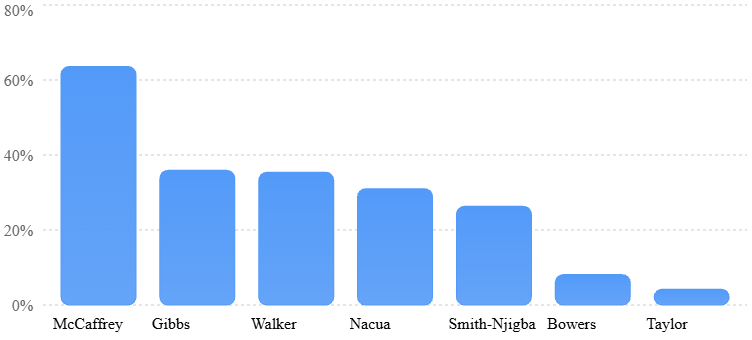
The three biggest opportunities are:
- McCaffrey versus lower-owned RBs: Taylor, Kyren Williams, and Bucky Irving create different salary and ownership combinations.
- Gibbs versus Detroit passing stacks: Goff and LaPorta provide leverage when Detroit’s touchdowns are concentrated through passing.
- Premium WR chalk versus alternative ceiling: Jefferson, Collins, and Watson allow lower-owned WR constructions without completely sacrificing modeled upside.
A useful principle for this slate is to keep some strong chalk but avoid combining every popular anchor into the same roster. The objective is to preserve enough ceiling while reducing duplicated lineup structures.
7. Three tournament-winning game scripts to target
Script A
San Francisco passing touchdowns dominate
Purdy and Kittle exceed expectations while McCaffrey fails to deliver the touchdown concentration his ownership requires. Bowers benefits from Las Vegas playing from behind.
Script B
Kansas City passing attack erupts
Mahomes distributes multiple touchdowns to Rice and Kelce. Garrett Wilson benefits from additional passing volume as the Jets attempt to keep pace.
Script C
GB–NE exceeds market expectations
Maye generates a strong fantasy performance, Green Bay’s passing game produces explosive plays, and the relatively low-owned environment becomes a significant tournament separator.
These are conditional scenarios, not predictions that all three will occur. They are useful because they define how a lineup wins rather than simply grouping together players with high individual projections.
8. My final SE / 3-Max player pool
| Position | Core targets | Contrarian additions |
|---|---|---|
| QB | Mahomes, Purdy, Allen | Maye, Goff, Prescott |
| RB | Gibbs, Kyren Williams, Javonte Williams | Taylor, Irving, Cook |
| WR | Nacua, Smith-Njigba, St. Brown, Lamb | Jefferson, Collins, Watson, Wilson |
| TE | Bowers, Kittle, Warren, Kelce | McBride, LaPorta, Fannin |
For single-entry, my preferred starting point is Mahomes with one or two Kansas City pass catchers, then choosing the remaining players according to salary, bring-back correlation, and ownership.
For 3-Max, I would diversify the primary stacks across KC–NYJ, DAL–IND, and GB–NE, rather than simply making three versions of the same lineup.
9. Five additional advantages worth exploiting
1. Salary opportunity cost: Mahomes saves $1,300 relative to Allen while surrendering only 1.9 modeled SACP. That salary can materially change the rest of the roster.
2. Double-TE flexibility: The depth of affordable tight ends means FLEXing a second TE may be viable when the alternative receiver lacks comparable ceiling.
3. Bring-back leverage: Garrett Wilson and Jonathan Taylor offer low-owned ways to access opposing offenses in favorable stacking environments.
4. Late-swap optionality: When roster construction permits, leave FLEX-eligible players in later-starting games and preserve salary flexibility. This creates options to pivot based on early results.
5. Differentiate by game script: Fading an entire high-total game is not always necessary. A Purdy passing stack instead of McCaffrey exposure can provide meaningful differentiation while retaining the same favorable environment.
Final verdict
DIAMOND LIFE — FINAL TOURNAMENT PRIORITIES
QB anchor
Patrick Mahomes
RB leverage
Jonathan Taylor
WR ceiling
Jaxon Smith-Njigba
TE ceiling
Brock Bowers
Value TE
Tyler Warren
Hidden game
GB–NE
The central strategy: Build around independently supported ceiling, use Vegas to identify favorable scoring conditions, and exploit ownership concentrations through alternative game scripts.
One caution before lock: the uploaded projections include some unusual player-team assignments and potentially uncertain starting roles. All player recommendations above are conditional on validating the actual slate, eligibility, injuries, and updated odds. The simulated SACP values are upside estimates, not expected scores or guaranteed tournament outcomes.


Leave a Reply