Executive summary
The Diamond Life NBA Solver #33 identifies three distinct ways to attack this slate: elite individual ceiling, underowned game environments, and injury-driven opportunity.
Our analysis moves beyond simply identifying the highest projected fantasy scorers. We combine Monte Carlo outcome distributions, NBA SACP v3.2, XVO v3.1, Right-Tail MME Separation, projected ownership (RST%), and available Vegas information to find where the field may be underestimating tournament-winning upside.
THE SLATE AT A GLANCE
Highest individual SACP
87.8
Nikola Jokic
Best Vegas-supported game
CLE–OKC
228.5 total · 2.5 spread
Best potential leverage anchor
Cade Cunningham
73.7 SACP · 7.8% RST
Highest aggregate game ceiling
ATL–WAS
506.7 top-five SACP
Our primary conclusion: CLE–OKC provides the strongest available confirmation between Vegas and the solver. DET–PHI offers an intriguing potential market disagreement, while ATL–WAS and DEN–TOR carry substantial raw ceiling but lack complete Vegas verification.
The most valuable tournament strategy is to target ceiling that the field has not fully priced into ownership, rather than automatically stacking the highest-total game.
Data qualification: This report reflects the uploaded Solver #33 dataset and our preceding analysis, not a verified live injury report. The workbook contains missing Vegas lines, unusual player-team assignments, and statistical proxy simulations. Team correlations and injury-dependent recommendations must be validated before lineup lock.
1. Game environments: Where should we attack?
Our first adjustment was to rank games using the five highest-projected players from each team, rather than summing every rostered player. This reduces the distortion created by unusually deep player pools.
Concentrated game ceiling by matchup
Combined SACP of each team’s five highest-projected players. These are sums of player ceilings, not joint game outcomes.
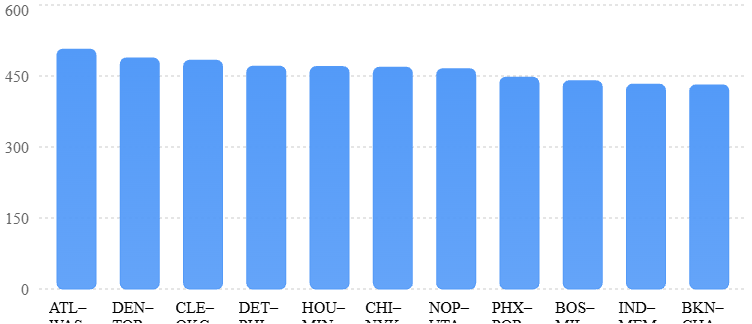
Game environment rankings
| Rank | Matchup | SACP | Strategy |
|---|---|---|---|
| 1 | ATL–WAS | 506.7 | High-ceiling tournament target |
| 2 | DEN–TOR | 488.1 | Elite-anchor environment |
| 3 | CLE–OKC | 483.1 | Best confirmed dual-source opportunity |
| 4 | DET–PHI | 470.7 | Potential leverage environment |
| 5 | HOU–MIN | 469.9 | Selective exposure; blowout risk |
| 6 | CHI–NYK | 468.5 | Strong secondary environment |
| 7 | NOP–UTA | 465.2 | Value-dependent opportunity |
| 8 | PHX–POR | 447.3 | Selective one-offs |
| 9 | BOS–MIL | 439.9 | Favor stronger individual plays |
| 10 | IND–MEM | 432.7 | Lower full-stack priority |
| 11 | BKN–CHA | 431.2 | First game underweight |
The major lesson is that aggregate ceiling and optimal tournament exposure are not the same thing.
ATL–WAS leads in raw ceiling, but without verified Vegas and player availability, we cannot conclude that it is the fastest or best actual game environment.
The four matchups with Vegas data
| Matchup | Total | Spread | Interpretation |
|---|---|---|---|
| CLE–OKC | 228.5 | 2.5 | Best scoring/competitiveness combination |
| HOU–MIN | 221.5 | 9.5 | Scoring opportunity with blowout risk |
| DET–PHI | 218.0 | 1.5 | Lower total, strong solver ceiling |
| BKN–CHA | 214.5 | 2.5 | Lower scoring and weaker solver ceiling |
These four games demonstrate why our dual-source approach matters.
CLE–OKC has the strongest agreement between the market and our ceiling projections. DET–PHI, meanwhile, deserves a closer look because the solver sees significant upside despite a relatively modest game total.
That discrepancy is a candidate market inefficiency, not proof that Vegas is wrong. It becomes actionable only when player-level ownership, rotations, and actual slate assignments confirm the opportunity.
2. The best individual spend-up anchors
A tournament-winning anchor should provide more than a high median projection. We want access to extreme upper-tail outcomes without sacrificing too much salary flexibility or accepting unnecessary ownership.
| Player | Salary | SACP | RST% |
|---|---|---|---|
| Nikola Jokic | $12,300 | 87.8 | 11.1% |
| Shai Gilgeous-Alexander | $10,300 | 80.4 | 10.0% |
| Jayson Tatum | — | 76.8 | 16.6% |
| Cade Cunningham | $9,300 | 73.7 | 7.8% |
| Alperen Sengun | $8,900 | 67.1 | 13.2% |
| Karl-Anthony Towns | — | 66.7 | 12.9% |
| Anthony Davis | — | 66.5 | 10.4% |
| Scottie Barnes | — | 65.4 | 9.7% |
| Jalen Brunson | — | 64.5 | 8.3% |
| Pascal Siakam | — | 63.0 | 8.9% |
Salary shown where established in our earlier analysis; other salaries are omitted rather than estimated.
Jokic: The raw-ceiling king
Jokic leads the slate with 87.8 SACP, providing the strongest individual ceiling foundation.
His primary obstacle is salary. At $12,300, rostering Jokic requires finding enough value elsewhere to avoid sacrificing too much upside across the remaining positions.
He is an attractive tournament anchor when credible value emerges through injuries or rotations.
SGA: The strongest Vegas-supported anchor
SGA combines 80.4 SACP, 10.0% projected ownership, and the strongest available Vegas-supported environment.
His $10,300 salary also creates more roster flexibility than Jokic.
For single-entry, SGA is my preferred conditional anchor because his individual ceiling and game environment reinforce one another.
Cade Cunningham: The leverage alternative
Cunningham may be the most interesting ownership-adjusted spend-up.
At $9,300, he provides 73.7 SACP with just 7.8% projected ownership.
The DET–PHI total is only 218, but the spread is 1.5, suggesting a potentially competitive environment. If the field favors higher-total games, Cunningham could provide a different path to a tournament-winning score.
He is my favorite spend-up candidate for exploiting a potential solver-versus-market discrepancy.
3. Best values and right-tail separators
The next group is where our Right-Tail MME Separation Engine becomes especially useful.
These players may not have the highest raw projections, but they provide potentially valuable combinations of salary efficiency, upper-tail outcomes, and low projected ownership.
| Player | Salary | SACP | RST% | Right-Tail |
|---|---|---|---|---|
| Amen Thompson | $7,300 | 50.6 | 2.4% | 6.3 |
| Paul Reed | $6,500 | 50.1 | 2.4% | 7.1 |
| Ajay Mitchell | $6,600 | 46.7 | 2.5% | 6.2 |
| Isaiah Hartenstein | $6,300 | 43.6 | 2.3% | 6.5 |
| Ausar Thompson | $6,000 | 40.8 | 1.3% | 6.8 |
| Alex Caruso | $4,600 | 38.4 | 5.1% | — |
| Daniss Jenkins | $4,500 | 33.9 | 1.6% | — |
| Adem Bona | $3,800 | 20.2 | 0.3% | — |
Three priority leverage targets
Amen Thompson — The underowned upside candidate
50.6 SACP at 2.4% ownership is a compelling combination. His value increases further if confirmed absences create additional ball-handling opportunities.
Risk: Houston’s 9.5-point recorded spread and rotation uncertainty.
Ajay Mitchell — The high-environment separator
46.7 SACP, 2.5% ownership, and a 6.2 Right-Tail score make him an intriguing alternative way to access CLE–OKC.
Risk: Minutes and usage must be validated before prioritizing him over higher-projected teammates.
Ausar Thompson — The low-owned tournament pivot
His 40.8 SACP and 1.3% ownership make him interesting in an environment where Cunningham already provides strong ceiling access.
Risk: Minutes, foul exposure, and offensive role variability.
The important distinction for readers: low ownership is not itself an edge. It becomes an edge when the player has a credible path to a score that can materially separate a lineup from the field.
4. Injury intelligence: Where opportunity could shift
The most important injury-related opportunities are concentrated around five rotations.
| Team | Injury trigger to monitor | Potential beneficiaries |
|---|---|---|
| Philadelphia | Embiid unavailable | Maxey, Bona |
| Detroit | Guard or frontcourt absence | Cunningham, Reed, Ausar, Jenkins |
| Oklahoma City | Guard or center absence | Ajay Mitchell, Hartenstein, Jaylin Williams |
| Denver | Jokic or Murray unavailable | Murray, Gordon, Jokic, Braun, depending on absence |
| Houston | Primary creator unavailable | Amen Thompson, Sengun, Durant |
These are conditional scenarios, not reports that those players are currently injured.
How the NBA SACP v3.2 model should respond
Our NBA-specific SACP model places additional emphasis on usage, efficiency, projected minutes, and upper-tail access.
When a significant player is ruled out, the correct workflow is:
- Remove the inactive player’s projection.
- Redistribute minutes based on plausible rotations.
- Reallocate usage and playmaking opportunities.
- Recalculate fantasy-point distributions and NBA-adjusted SACP.
- Refresh ownership and Right-Tail Separation.
- Compare the new option against the best foregone salary alternative.
For example, if Embiid were unavailable, Bona might gain minutes and Maxey might gain usage. But those changes would need to be quantified independently.
A cheap backup does not automatically become a tournament core merely because a starter is out.
The best injury-driven play is the player whose increase in ceiling exceeds the increase in projected ownership.
5. Risk management: Which games should we avoid?
The Monte Carlo framework is most useful when we distinguish a player’s raw ceiling from the probability of achieving it.
A game with several high-P95 players may still be a poor stacking environment if the players compete for the same usage, face substantial blowout risk, or lack dependable minutes.
Game-level risk classifications
| Environment | Risk | Recommended approach |
|---|---|---|
| CLE–OKC | Moderate | Prioritize anchors and selective correlations |
| ATL–WAS | Elevated | High-upside GPP exposure, pending validation |
| DEN–TOR | Moderate to elevated | Elite anchors, salary-aware construction |
| DET–PHI | Injury-sensitive | Favor verified usage beneficiaries |
| HOU–MIN | Blowout-sensitive | Selective one-offs over heavy stacking |
| CHI–NYK | Moderate | Secondary ceiling opportunities |
| BKN–CHA | Lower ceiling | Underweight full-game stacks |
| IND–MEM | Lower concentration | Prefer isolated value plays |
| BOS–MIL | Uneven team ceilings | Favor strongest individual options |
These are qualitative risk assessments based on the available projections and market data, not independently simulated probabilities of a game stack succeeding.
The fragile-chalk principle
A popular player becomes a potential fade when three things happen simultaneously: ownership rises, his ceiling advantage over alternatives narrows, and his downside remains significant.
Our strategy is not to fade chalk simply because it is popular. Instead, we should seek meaningfully lower-owned pivots that retain strong SACP and P99 access.
For example, SGA and Cunningham should not be treated as identical plays. SGA has the higher raw ceiling and stronger Vegas-supported environment. Cunningham costs $1,000 less, carries lower ownership, and offers a different tournament outcome.
That is a legitimate opportunity-cost decision.
6. Single-entry, 3-Max, and MME strategy
Single Entry — Prioritize confirmed ceiling
My initial preference is SGA as the primary anchor, with Cunningham as the ownership-adjusted alternative.
Favor reliable minutes and strong P90–P99 access. Limit speculative injury beneficiaries until their rotations are confirmed.
3-Max — Diversify the ways to win
Consider three distinct constructions: a CLE–OKC ceiling build, a Jokic-centered DEN–TOR build, and a lower-owned Cunningham-centered build.
This diversifies salary allocation, game environments, and ownership rather than relying on one outcome across all entries.
MME — Attack right-tail separation
Broaden exposure to lower-owned players with credible upper-tail outcomes, including Amen Thompson, Ajay Mitchell, Ausar Thompson, and Paul Reed.
Avoid overconcentrating in one game or relying on multiple players whose ceiling scenarios compete with one another.
7. Final condensed player pool
The following pool is a research shortlist from Solver #33, not a verified active-player list.
| Role | Priority candidates |
|---|---|
| Elite ceiling anchors | Jokic, SGA, Tatum |
| Ownership-adjusted spend-ups | Cunningham, Brunson, Barnes |
| Secondary ceiling plays | Sengun, Towns, Anthony Davis, Siakam |
| Underowned upside | Amen Thompson, Ajay Mitchell, Hartenstein |
| Right-tail separators | Paul Reed, Ausar Thompson |
| Conditional salary relief | Jenkins, Caruso, Bona |
Five decisions that could define the slate
- SGA versus Jokic: Is Jokic’s additional 7.4 SACP worth the extra $2,000 in salary?
- Cunningham versus the field: Will his lower-owned ceiling compensate for the less attractive Vegas environment?
- CLE–OKC secondary exposure: Which supporting players have genuinely compatible ceiling paths with the stars?
- Houston’s ownership gap: Can Amen Thompson outperform his 2.4% projected ownership without relying on an unconfirmed injury?
- Late injury value: Which confirmed absence creates the largest positive SACP adjustment relative to the ownership increase?
8. Final Diamond Life verdict
The slate’s most interesting opportunities are not necessarily found in the highest-scoring games. They emerge where Vegas scoring expectations, independent solver ceilings, and projected ownership fail to align perfectly.
Our strongest provisional conclusions are:
- Best Vegas-supported game: CLE–OKC.
- Best raw-ceiling anchor: Nikola Jokic.
- Best alternative anchor: Shai Gilgeous-Alexander.
- Best potential ownership-adjusted spend-up: Cade Cunningham.
- Most interesting secondary leverage targets: Amen Thompson, Ajay Mitchell, and Ausar Thompson.
- Most interesting potential market disagreement: DET–PHI.
- First full-game underweight: BKN–CHA.
Before lineup lock
There are three material limitations readers should understand.
First, seven game environments lack verified Vegas totals in the workbook. Second, several player-team assignments appear inconsistent, making the game-level correlations provisional. Third, the current file contains no confirmed zero-projection injury removals, so the injury swaps remain scenarios rather than completed recalculations.
The solver’s 15,000 statistical proxy draws also should not be interpreted as a fully validated possession-by-possession simulation.
The Diamond Life edge is a disciplined process, not a single projection: identify upper-tail opportunity, confirm the game environment, evaluate salary and ownership, then adjust for late-breaking rotation news before the field fully reacts.
That is how we move from simply identifying good NBA DFS plays to identifying the plays that can separate us in tournaments.


Leave a Reply