World Wide Technology Championship
El Cardonal at Diamante
World Wide Technology Championship
El Cardonal at Diamante
Diamond Life PGA DFS Solver — Full Slate Analysis
Analysis completed
I’ve processed all 115 golfers in your uploaded slate using the Diamond Life PGA framework, including ceiling distributions, SACP, XVO v3.1-style scoring, ownership leverage, and salary-adjusted Right-Tail MME Separation.
Solver workbook
Excel export
Download Diamond Life PGA Solver Results
Model qualification: This run uses 30,000 simulated scoring scenarios per golfer, calibrated to uploaded projections and cut histories. It is a preliminary statistical proxy, not the full correlated 50,000-simulation PGA engine. Weather, course-specific fit, and live betting odds have not been independently verified.
1. Slate overview
115
Eligible golfers
13.9%
Highest RST%
112.4
Top SACP
The most interesting characteristic is the relatively flat ownership distribution. No golfer exceeds 14% projected ownership, creating opportunities to roster substantial ceiling without paying the ownership premiums common on stronger-field slates.
The solver highlights three potential advantages: premium golfers with closely matched ceilings, an unusually attractive $6,700–$7,800 salary region, and low-owned golfers who can provide tournament separation.
2. Top 10 SACP golfers
| Rank | Golfer | Salary | RST% | SACP |
|---|---|---|---|---|
| 1 | Jackson Koivun | $10,400 | 11.3% | 112.4 |
| 2 | Ben James | $9,900 | 11.7% | 111.4 |
| 3 | Blades Brown | $9,500 | 13.9% | 110.7 |
| 4 | Ben Griffin | $10,000 | 8.4% | 110.5 |
| 5 | Keith Mitchell | $9,600 | 10.6% | 103.6 |
| 6 | Jackson Suber | $9,200 | 9.5% | 101.5 |
| 7 | Pierceson Coody | $8,600 | 6.7% | 101.1 |
| 8 | Zach Bauchou | $7,800 | 8.2% | 100.1 |
| 9 | Andrew Putnam | $6,700 | 5.1% | 99.9 |
| 10 | Steven Fisk | $8,200 | 6.9% | 99.5 |
SACP = 55% P95 + 25% P90 + 20% P99. Values are scenario-model estimates, not guaranteed scoring outcomes.
Top PGA SACP projections
Top eight golfers by modeled SACP
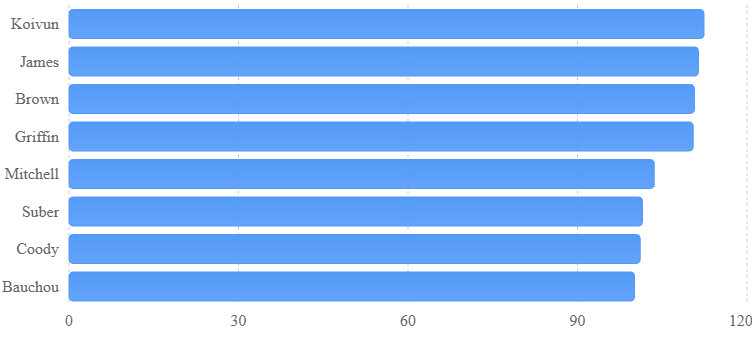
| Name | Sacp |
|---|---|
| Koivun | 112.4 |
| James | 111.4 |
| Brown | 110.7 |
| Griffin | 110.5 |
| Mitchell | 103.6 |
| Suber | 101.5 |
| Coody | 101.1 |
| Bauchou | 100.1 |
3. Best spend-up anchors
Ben Griffin PGA TOUR Player Profile, Stats, Bio, Career
Ben Griffin
Preferred ownership pivot
$10,000 · 8.4% RST · 110.5 SACP
Griffin offers nearly the same modeled ceiling as the top three golfers at lower projected ownership. He is my preferred premium tournament anchor when prioritizing separation.
Blades Brown
$9,500 · 13.9% RST · 110.7 SACP
Brown leads the uploaded field in baseline FPTS at 77.34. His $9,500 salary is appealing, but he also carries the highest ownership. Strong play, not an automatic fade.
Keith Mitchell PGA TOUR Player Profile, Stats, Bio, Career
Keith Mitchell
$9,600 · 10.6% RST · 103.6 SACP
Mitchell trails the leading ceiling group, making him a secondary anchor rather than a priority over Griffin or Brown. His value improves if verified course and weather conditions favor his strengths.
Jackson Koivun and Ben James also belong in the premium pool. Koivun owns the highest modeled SACP, while James offers comparable upside for $500 less. Their projections are close enough that salary construction and ownership should determine exposure.
4. Best value golfers
This is where the slate becomes particularly interesting.
| Golfer | Salary | RST% | SACP |
|---|---|---|---|
| Andrew Putnam | $6,700 | 5.1% | 99.9 |
| Zach Bauchou | $7,800 | 8.2% | 100.1 |
| Sudarshan Yellamaraju | $7,400 | 7.1% | 99.1 |
| Kevin Yu | $7,600 | 7.0% | 98.8 |
| Max McGreevy | $7,100 | 4.7% | 98.5 |
| Rico Hoey | $7,600 | 6.8% | 98.2 |
Andrew Putnam is the standout value. His $6,700 salary and 99.9 modeled SACP create a compelling salary-adjusted profile. The projection model places him surprisingly close to golfers costing several thousand dollars more.
However, because the simulation uses a simplified cut/miss distribution, Putnam’s high modeled ceiling needs additional validation through course fit, scoring history, and betting markets before treating him as a true elite upside play.
Bauchou and Yellamaraju offer attractive middle-tier alternatives for more balanced builds.
5. Right-tail separators and sleepers
The salary-adjusted Right-Tail MME model identifies these golfers as leading leverage candidates:
| Rank | Golfer | Salary | RST% | Separation |
|---|---|---|---|---|
| 1 | Vince Whaley | $6,400 | 3.1% | 12.85 |
| 2 | Andrew Putnam | $6,700 | 5.1% | 12.46 |
| 3 | Aldrich Potgieter | $6,400 | 3.7% | 12.37 |
| 4 | David Lipsky | $6,300 | 4.5% | 12.34 |
| 5 | Matt Kuchar | $6,600 | 3.2% | 12.29 |
| 6 | Mark Hubbard | $6,200 | 4.2% | 12.24 |
| 7 | Lucas Glover | $6,600 | 3.8% | 12.22 |
| 8 | Max McGreevy | $7,100 | 4.7% | 11.76 |
These rankings favor salary efficiency and ownership-adjusted upper-tail access. They do not mean these golfers have the highest absolute chances of winning.
My initial tournament preference is Putnam and McGreevy for combining relatively strong absolute ceiling with value, while Whaley and Potgieter are more speculative salary-saving separators.
6. Single-entry versus MME strategy
Single-entry
Prioritize Griffin or Brown as the premium anchor, then build around one or two golfers from the Putnam, Bauchou, Yellamaraju and McGreevy group. Avoid introducing too many low-probability punts solely to lower cumulative ownership.
3-Max
Diversify the premium position across Griffin, Koivun and Brown. Rotate value combinations rather than constructing three nearly identical teams. Consider a Coody or Fisk configuration as a way to reduce the cost of the upper tier.
Large-field MME
Expand the value pool to Whaley, Potgieter, Lipsky, Kuchar, Hubbard and Glover. Their low ownership creates possible leverage, but their modeled tail access should be checked against actual cut and top-finish probabilities before increasing exposures.
7. Fragile chalk and opportunity cost
Brown is the highest-owned golfer, but at only 13.9%, he is not extreme chalk. His baseline projection and salary make him a defensible play.
The more important opportunity-cost question is whether paying $10,400 for Koivun is justified when James, Brown and Griffin have closely grouped SACP projections.
For example, Griffin sacrifices only about 1.9 SACP points versus Koivun, saves $400 and carries 2.9 percentage points less projected ownership. That makes Griffin an attractive tournament pivot on the current model.
Similarly, Coody at $8,600 and Bauchou at $7,800 can unlock substantial salary without surrendering as much modeled ceiling as their prices suggest.
8. Final condensed PGA player pool
| Role | Priority golfers |
|---|---|
| Premium anchors | Griffin, Koivun, Brown, James |
| Secondary spend-ups | Mitchell, Suber |
| Upper-middle targets | Coody, Fisk, Greyserman |
| Core values | Putnam, Bauchou, Yellamaraju, Kevin Yu |
| Value pivots | McGreevy, Rico Hoey |
| Low-owned separators | Whaley, Potgieter, Lipsky, Kuchar |
| Deep MME alternatives | Hubbard, Glover |
9. What could change the rankings?
The biggest remaining variables are weather and tee-time draw, course-specific skill requirements, and the reliability of the uploaded cut-history percentages. One data-quality issue is that at least one golfer has a CUT% above 100, so that field cannot be treated as a literal probability without correction.
The workbook clips cut probabilities to a reasonable range and documents the assumption. That makes the output usable for preliminary comparison, but not a fully calibrated PGA predictive model.
Final solver priorities
For this preliminary slate read, Ben Griffin is my preferred tournament anchor, Blades Brown is the leading salary-conscious premium alternative, and Andrew Putnam is the most interesting value to investigate further.
Vince Whaley leads the salary-adjusted separation rankings, but I would treat him as an MME candidate rather than a single-entry core until the course and cut-risk evidence supports the projection.


Leave a Reply