Diamond Life DFS Solves NBA 10/28/26 Main Slate (DK) – Early and Edgy
Diamond Life NBA DFS: Full Slate Breakdown
October 28, 2026 | SACP v3.2 | Vegas Convergence | Right-Tail Leverage | Injury Strategy
The NBA DFS tournament edge isn’t simply finding the highest-projected players or targeting the games with the biggest Vegas totals. It’s identifying situations where Vegas expects scoring, our Diamond Life Solver independently identifies substantial ceiling potential, and projected ownership has not fully caught up.
For this slate, our analysis points toward three primary game environments: Atlanta–Miami, Denver–New Orleans, and Indiana–Philadelphia. Cleveland–Washington offers a higher-risk alternative with considerable tournament separation potential.
We also have several individual players whose SACP ceilings stand out relative to projected ownership, including Jalen Johnson, Amen Thompson, and Brandon Miller.
This report brings together our Monte Carlo modeling, PER/USG-enhanced SACP v3.2, XVO v3.1, right-tail separation, Vegas environments, ownership, and conditional injury adjustments.
Data note: Figures reflect the uploaded contest player pool and prior solver outputs, not independently verified live NBA rosters or injury reports. Some team assignments in the file are unusual, so game-specific recommendations require slate verification. Ownership percentages are projections, not confirmed field ownership.
1. Understanding the slate: Vegas versus the solver
Our first task is to determine which games offer the strongest combination of scoring, concentrated fantasy production, and tournament-winning ceilings.
| Game | Vegas O/U | Spread | Combined SACP | Avg. Right-Tail |
|---|---|---|---|---|
| ATL–MIA | 241.5 | 3.5 | 735.2 | 11.8 |
| DEN–NOP | 241.5 | 4.5 | 725.0 | 10.9 |
| IND–PHI | 237.0 | 5.0 | 712.6 | 11.4 |
| CLE–WAS | 239.0 | 9.5 | 712.9 | 13.5 |
| NYK–CHI | 234.5 | 7.5 | 700.8 | 10.0 |
| GSW–MIN | 228.5 | 3.5 | 692.0 | 11.9 |
| HOU–MIL | 226.5 | 8.5 | 679.4 | 12.8 |
| DET–CHA | 214.5 | 6.5 | 670.7 | 13.4 |
| ORL–TOR | 222.0 | 4.5 | 667.1 | 11.8 |
Combined SACP represents the sum of individual player ceiling estimates, not a projected game score. Average right-tail scores are relative separation indicators, not game-level probabilities.
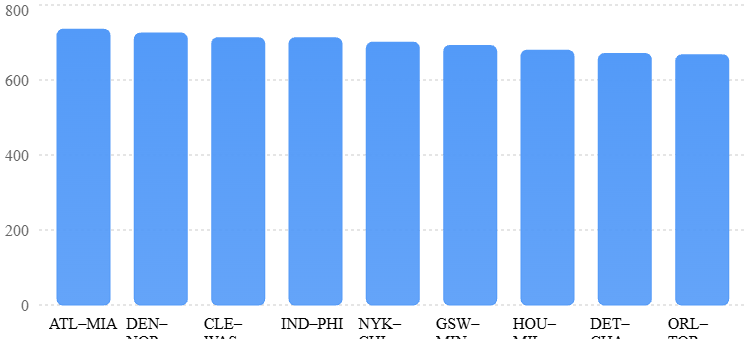
Combined SACP by game
Modeled player-ceiling supply across both teams
| Game | Sacp |
|---|---|
| ATL–MIA | 735.2 |
| DEN–NOP | 725 |
| CLE–WAS | 712.9 |
| IND–PHI | 712.6 |
| NYK–CHI | 700.8 |
| GSW–MIN | 692 |
| HOU–MIL | 679.4 |
| DET–CHA | 670.7 |
| ORL–TOR | 667.1 |
What the numbers reveal
Atlanta–Miami leads the slate in combined SACP, while Denver–New Orleans offers the most compelling elite individual anchor in Nikola Jokic.
Indiana–Philadelphia deserves more attention than its lower total might suggest. Its average player SACP is 37.5, compared with Denver–New Orleans at 33.0.
Cleveland–Washington is perhaps the most interesting tournament situation. The 239 total signals strong offensive expectations, while its average right-tail separation of 13.5 is the highest among the games with totals above 230.
The drawback is a 9.5-point spread. If Cleveland dominates early, fourth-quarter minutes could disappear. If Washington keeps the game competitive, the same environment could generate significant fantasy upside.
This is the central Diamond Life principle: ceiling must be evaluated alongside the probability of accessing that ceiling.
2. The four game environments that matter most
1. Atlanta vs. Miami
Best Vegas–solver convergence
241.5 total | 3.5 spread | 735.2 combined SACP
The combination of elite scoring expectations, the highest combined ceiling, and a competitive spread makes this the strongest overall game environment in the supplied data.
Jalen Johnson is the standout. His 79.5 SACP and 5.3% projected ownership create one of the slate’s clearest opportunities for tournament separation.
Tournament approach: Prioritize Johnson, then evaluate selective secondary exposure rather than automatically stacking every high-usage player.
2. Denver vs. New Orleans
241.5 total | 4.5 spread | 725.0 combined SACP
Nikola Jokic leads the entire player pool with a 97.6 SACP and only 12.3% projected ownership.
Jamal Murray (62.7 SACP), Dejounte Murray (59.8), and Zion Williamson (56.4) provide additional modeled ceiling opportunities.
Tournament approach: Jokic is the primary anchor candidate. The decision should ultimately depend on salary efficiency and the quality of players sacrificed to afford him.
3. Indiana vs. Philadelphia
237.0 total | 5.0 spread | 712.6 combined SACP
This environment combines competitive scoring with several strong individual ceilings.
Joel Embiid (71.4), Tyrese Maxey (64.7), and Tyrese Haliburton (63.9) are the principal solver targets.
Tournament approach: Excellent for selective two-player correlations, especially when projected ownership remains moderate.
4. Cleveland vs. Washington
239.0 total | 9.5 spread | 712.9 combined SACP
This is the higher-variance alternative to the top three games.
Donovan Mitchell (71.8 SACP) and Evan Mobley (61.3) illustrate the ceiling available in this environment.
Tournament approach: Use selectively in large-field contests. The optimal scenario is a competitive fourth quarter that preserves starter minutes.
3. Top spend-up anchors
Our PER/USG-enhanced SACP v3.2 places additional emphasis on high-usage players who combine strong efficiency with access to upper-percentile outcomes.
| Rank | Player | SACP v3.2 | RST% | Assessment |
|---|---|---|---|---|
| 1 | Nikola Jokic | 97.6 | 12.3% | Highest raw ceiling |
| 2 | Giannis Antetokounmpo | 89.9 | 14.1% | Elite usage-driven ceiling |
| 3 | Jalen Johnson | 79.5 | 5.3% | Outstanding leverage |
| 4 | Karl-Anthony Towns | 78.3 | — | Strong frontcourt alternative |
| 5 | Donovan Mitchell | 71.8 | — | High-upside scoring anchor |
| 6 | Joel Embiid | 71.4 | 9.0% | Strong tournament spend-up |
| 7 | Cade Cunningham | 70.1 | — | Concentrated offensive role |
| 8 | Anthony Davis | 66.6 | — | High-ceiling alternative |
A dash indicates that an exact ownership value was not established in the preceding analysis.
Anchor strategy
Jokic has the highest modeled raw ceiling and should be the first expensive player evaluated. Johnson, however, may be the more interesting tournament building block because of his lower projected ownership.
Embiid becomes particularly useful if the field concentrates on Jokic and Giannis, provided Philadelphia’s injury situation is favorable.
The key is not simply selecting the player with the highest SACP. It is finding the anchor who offers the greatest ceiling advantage relative to salary, ownership, and the alternatives being sacrificed.
4. Best value plays and salary-adjusted opportunities
Tournament value is not simply a low salary attached to a decent median projection. We want players capable of producing outcomes well above what their salary and ownership imply.
| Player | Salary | SACP | RST% | Tournament appeal |
|---|---|---|---|---|
| Amen Thompson | $7,000 | 58.0 | 3.3% | Strong ceiling leverage |
| Evan Mobley | $7,900 | 61.3 | — | High-upside frontcourt option |
| James Harden | $7,400 | 55.5 | 10.3% | Usage-driven upside |
| Onyeka Okongwu | $5,700 | 46.5 | 3.8% | Salary-efficient frontcourt target |
| Nickeil Alexander-Walker | $6,400 | 49.2 | 5.4% | Secondary offensive ceiling |
| Jabari Smith Jr. | — | 47.5 | — | Conditional usage opportunity |
These players deserve consideration because they provide meaningful ceiling access without necessarily requiring the same salary commitment as the elite anchors.
Amen Thompson is especially intriguing. His 58.0 SACP and 3.3% projected ownership create a potential tournament advantage even though Houston–Milwaukee carries only a 226.5 total.
This is an example of the solver finding individual upside in a game that Vegas does not consider particularly explosive.
5. Best sleepers and right-tail separators
Our Right-Tail MME Separation Engine emphasizes P90, P95, P99, volatility, salary efficiency, and projected ownership.
For large-field tournaments, these are the types of players who can make a difference between a solid lineup and a genuinely differentiated one.
Jalen Johnson
5.3% RST
79.5 SACP
The strongest combination of raw ceiling, projected ownership, and favorable game environment among the highlighted players. An excellent candidate for single-entry and 3-Max consideration.
Brandon Miller
2.2% RST
64.0 SACP
The Detroit–Charlotte game has the slate’s lowest total, but Miller offers substantial individual ceiling at extremely low projected ownership. Better suited to selective GPP exposure than broad game stacking.
Amen Thompson
3.3% RST
58.0 SACP
An attractive lower-owned play with additional upside if Houston experiences an injury-related redistribution of usage.
These ownership discounts are only valuable if the players’ modeled ceilings remain realistic after accounting for minutes, role, salary, and updated injury information.
6. Injury situations that could reshape the slate
Injury news is where our PER/USG-enhanced model becomes especially valuable.
When a high-usage player is unavailable, teammates can benefit from increased minutes, additional possessions, higher usage, and improved opportunities to reach their ceiling.
But not every replacement benefits equally. A player who gains eight minutes without receiving more offensive responsibility may experience a smaller ceiling improvement than a player who gains four minutes and becomes a primary ball handler.
Conditional injury-adjustment watchlist
| If player is out | Solver target to reassess | Baseline SACP | Expected impact |
|---|---|---|---|
| Joel Embiid | Tyrese Maxey | 64.7 | Increased scoring and usage |
| Kevin Durant | Amen Thompson | 58.0 | More offensive opportunities |
| Donovan Mitchell | James Harden | 55.5 | Increased creation responsibility |
| Nikola Jokic | Jamal Murray | 62.7 | Higher usage, but potentially lower team efficiency |
| Jalen Johnson | Onyeka Okongwu | 46.5 | More frontcourt responsibility |
| Cade Cunningham | Ausar Thompson | ~44 | Potential minutes and peripheral-stat increase |
| Karl-Anthony Towns | Jalen Brunson | ~66 | Increased offensive concentration |
These are hypothetical scenarios, not confirmed injuries. Baseline SACP values should not be mistaken for post-injury projections.
The injury opportunity the field may miss
Consider a hypothetical Kevin Durant absence.
Many DFS players would immediately look for the cheapest replacement starter. Our solver instead asks whether Amen Thompson gains enough usage and fantasy production to materially increase his P95 and P99 outcomes.
That distinction matters. The cheapest replacement may become popular without having the highest tournament-winning upside.
The most profitable injury situations often involve a second beneficiary whose ceiling increases before ownership projections fully adjust.
7. Game environments to avoid overstacking
There are three games I would approach cautiously.
Detroit–Charlotte (214.5 total): The lowest Vegas total on the slate makes a full-game stack difficult to justify without a compelling simulation result. Brandon Miller remains a viable individual right-tail candidate.
Orlando–Toronto (222.0 total): The lowest combined SACP in the uploaded data suggests limited overall ceiling supply. Concentrated individual opportunities are preferable to broad exposure.
Houston–Milwaukee (226.5 total): The 8.5-point spread introduces additional game-script risk. However, Amen Thompson and other usage beneficiaries could still offer meaningful tournament leverage.
Avoiding an environment does not mean eliminating every player from that game. It means requiring a stronger individual ceiling, salary, or ownership advantage before committing roster spots.
8. Single-entry versus 3-Max versus MME strategy
| Contest type | Main focus | Preferred approach |
|---|---|---|
| Single-entry | Ceiling with controlled risk | Build around one elite anchor and several salary-efficient ceiling plays |
| 3-Max | Multiple high-upside game outcomes | Diversify primary environments and anchor combinations |
| Large-field MME | P95/P99 separation | Increase selective exposure to underowned, volatile outcomes |
Single-entry
Atlanta–Miami and Denver–New Orleans offer the strongest starting points.
Jokic provides the highest raw ceiling, while Jalen Johnson presents a particularly compelling combination of ceiling and projected ownership.
The optimal construction should not force both players into a lineup if doing so creates unacceptable salary sacrifices elsewhere.
3-Max
A sensible three-construction framework would be:
- An Atlanta–Miami-focused build emphasizing Jalen Johnson.
- A Denver–New Orleans build anchored by Jokic.
- A more contrarian Cleveland–Washington or Indiana–Philadelphia build.
These are strategic frameworks, not generated lineups. Each construction still requires salary and positional validation.
Large-field MME
This is where Amen Thompson, Brandon Miller, and selective Cleveland–Washington exposure become especially interesting.
The objective is to capture outcomes that the field may be underrepresenting, without overexposing the portfolio to fragile game scripts.
9. Final condensed Diamond Life player pool
| Category | Primary candidates |
|---|---|
| Elite anchors | Jokic, Giannis, Jalen Johnson |
| Alternative spend-ups | Towns, Embiid, Mitchell, Cunningham |
| Strong secondary plays | Maxey, Jamal Murray, Mobley |
| Salary-conscious upside | Amen Thompson, Okongwu, Alexander-Walker |
| Contrarian right-tail | Brandon Miller, Amen Thompson |
| Conditional injury boosts | Maxey, Harden, Okongwu, Ausar Thompson |
This is a preliminary strategic pool rather than a final roster-ready list. Player eligibility, team assignments, injury statuses, and the latest ownership projections must be confirmed before entries are submitted.
10. Final slate outlook
DIAMOND LIFE — TOURNAMENT PRIORITIES
Highest raw ceiling
Nikola Jokic
97.6 SACP
Best highlighted leverage
Jalen Johnson
79.5 SACP / 5.3% RST
Contrarian value target
Amen Thompson
58.0 SACP / 3.3% RST
High-risk game environment
CLE–WAS
239 total / 9.5 spread
The biggest takeaway from this discovery is that our upgraded NBA Diamond Life Solver allows us to distinguish between high-scoring games, high-ceiling players, and genuinely differentiated tournament opportunities.
Atlanta–Miami stands out for its combination of Vegas scoring expectations and modeled player ceilings. Denver–New Orleans offers the strongest individual anchor. Indiana–Philadelphia provides an appealing alternative, while Cleveland–Washington carries significant upside if its competitive-game scenario materializes.
The injury layer adds another dimension. When a high-usage player becomes unavailable, we should not simply promote the next starter. We should rerun the entire distribution of minutes, usage, efficiency, and right-tail outcomes to identify which player gains the most tournament-winning equity.
Our final Diamond Life principle: The objective isn’t to roster the players most likely to produce acceptable fantasy scores. It’s to identify players whose probability of reaching a slate-breaking outcome is greater than their salary and projected ownership suggest.


Leave a Reply