Diamond Life DFS Casino Solves NFL Week 7 – Deeper Dive! (DK AND FD Week 7 Main Slates)
Draft King- Full Tournament Slate Report | October 24, 2026
The slate presents a clear distinction between high-projection environments and high-leverage tournament environments.
Detroit–Green Bay stands out as the strongest overall scoring environment, with the highest listed Vegas total and combined offensive SACP. Cincinnati–Baltimore and Los Angeles–Las Vegas offer particularly interesting quarterback stacking opportunities because Joe Burrow and Matthew Stafford carry substantially less ownership than the premier skill-position players attached to them.
The biggest strategic decision is how to approach concentrated ownership on Puka Nacua, Jahmyr Gibbs, George Kittle, and Bo Nix. These players have legitimate ceiling potential, so fading them all would introduce unnecessary risk. Instead, our Diamond Life approach should preserve elite upside while finding differentiation through lower-owned quarterbacks, secondary receivers, tight ends, and correlated game stacks.
Top game total
53.5
DET–GB
Top player SACP
62.5
Puka Nacua
Top QB SACP
37.2
Brock Purdy
All numerical findings below use the previously reported Solver #45 outputs. SACP and percentile ceilings are simulated proxies, not independently calibrated forecasts. Game totals and player availability have not been independently reverified.
1. Top solver plays by position
These rankings prioritize SACP, with RST% showing ownership concentration.
Quarterbacks
| Rank | Player | Salary | RST% | P95 | SACP |
|---|---|---|---|---|---|
| 1 | Brock Purdy | $6,600 | 9.1% | 33.8 | 37.2 |
| 2 | Joe Burrow | $6,900 | 6.8% | 32.2 | 35.7 |
| 3 | Bo Nix | $5,000 | 20.2% | 31.8 | 35.6 |
| 4 | Jordan Love | $6,000 | 7.8% | 31.8 | 35.1 |
| 5 | Lamar Jackson* | $6,700 | 4.5% | 31.1 | 35.0 |
| 6 | Jared Goff | $6,800 | 5.9% | 30.6 | 33.8 |
| 7 | Bryce Young | $5,900 | 7.3% | 30.1 | 33.6 |
| 8 | C.J. Stroud | $5,700 | 5.4% | 30.2 | 33.4 |
| 9 | Matthew Stafford | $6,400 | 3.9% | 28.9 | 31.8 |
| 10 | Kyler Murray* | $5,400 | 4.8% | 27.1 | 29.7 |
QB conclusion: Purdy leads raw ceiling. Burrow offers the strongest combination of high-end SACP and modest ownership. Stroud and Stafford are interesting tournament pivots. Nix is the salary-value option but also the most popular QB in this group.
Running backs
| Rank | Player | Salary | RST% | P95 | SACP |
|---|---|---|---|---|---|
| 1 | Jahmyr Gibbs | $9,800 | 33.4% | 49.0 | 55.2 |
| 2 | Bijan Robinson | $8,500 | 22.1% | 47.1 | 53.0 |
| 3 | Christian McCaffrey | $7,600 | 21.5% | 41.3 | 47.3 |
| 4 | Kyren Williams | $7,000 | 23.8% | 37.8 | 43.0 |
| 5 | Jonathan Taylor | $8,000 | 3.2% | 34.6 | 39.0 |
| 6 | Ashton Jeanty | $6,500 | 8.2% | 33.3 | 37.4 |
| 7 | Bucky Irving | $6,100 | 10.9% | 33.6 | 37.2 |
| 8 | Derrick Henry | $7,900 | 3.4% | 32.0 | 36.3 |
| 9 | Chuba Hubbard | $6,700 | 9.4% | 31.8 | 35.8 |
| 10 | Chase Brown | $6,600 | 5.8% | 29.6 | 33.8 |
RB conclusion: Gibbs has the highest raw ceiling, but Bijan is my preferred tournament alternative. Taylor and Henry are the deeper leverage options.
Wide receivers
| Rank | Player | Salary | RST% | P95 | SACP |
|---|---|---|---|---|---|
| 1 | Puka Nacua | $8,400 | 35.0% | 53.5 | 62.5 |
| 2 | Amon-Ra St. Brown | $7,800 | 26.2% | 41.6 | 48.0 |
| 3 | Ja’Marr Chase | $8,100 | 18.0% | 40.1 | 46.6 |
| 4 | Zay Flowers | $6,900 | 23.6% | 40.0 | 45.5 |
| 5 | Nico Collins | $7,200 | 9.3% | 37.8 | 42.1 |
| 6 | Drake London | $7,500 | 8.2% | 37.1 | 41.8 |
| 7 | Christian Watson | $7,000 | 17.6% | 36.7 | 41.7 |
| 8 | Justin Jefferson | $7,300 | 10.2% | 34.9 | 40.1 |
| 9 | Garrett Wilson | $6,500 | 17.7% | 34.4 | 39.3 |
| 10 | Jalen Coker | $6,100 | 17.4% | 33.4 | 38.9 |
WR conclusion: Puka is the clear raw-ceiling leader. Collins and London provide strong alternatives for tournament differentiation, while Chase offers elite upside at more moderate ownership.
Tight ends
| Rank | Player | Salary | RST% | P95 | SACP |
|---|---|---|---|---|---|
| 1 | Brock Bowers | $7,700 | 8.3% | 37.8 | 44.1 |
| 2 | George Kittle | $5,700 | 28.6% | 37.8 | 43.9 |
| 3 | Trey McBride | $7,400 | 3.2% | 34.5 | 39.3 |
| 4 | Isaiah Likely* | $5,300 | 2.0% | 28.3 | 33.0 |
| 5 | Sam LaPorta | $4,800 | 15.0% | 28.8 | 32.4 |
| 6 | Tucker Kraft | $4,700 | 6.3% | 25.8 | 28.7 |
| 7 | Harold Fannin | $4,200 | 7.7% | 24.2 | 28.3 |
| 8 | T.J. Hockenson | $4,500 | 3.3% | 22.4 | 25.3 |
| 9 | Tyler Higbee | $3,500 | 13.9% | 21.1 | 24.1 |
| 10 | Mark Andrews | $3,900 | 4.4% | 20.4 | 23.0 |
TE conclusion: Kittle has excellent ceiling per dollar, but Bowers and McBride provide considerable ownership leverage. LaPorta and Kraft offer midrange salary relief.
Defenses
| Rank | Defense | Salary | RST% | P95 | SACP |
|---|---|---|---|---|---|
| 1 | Houston Texans | $3,400 | 7.9% | 18.0 | 20.0 |
| 2 | New York Jets | $2,900 | 6.9% | 17.1 | 19.5 |
| 3 | Minnesota Vikings | $3,500 | 4.5% | 17.2 | 19.1 |
| 4 | Cleveland Browns | $2,800 | 7.2% | 16.4 | 18.8 |
| 5 | Denver Broncos | $3,300 | 3.4% | 15.6 | 17.8 |
| 6 | Tennessee Titans | $2,600 | 7.2% | 15.3 | 17.0 |
| 7 | Carolina Panthers | $3,000 | 2.9% | 12.8 | 14.5 |
| 8 | San Francisco 49ers | $3,200 | 2.0% | 12.3 | 13.6 |
| 9 | Los Angeles Rams | $3,100 | 2.0% | 11.7 | 13.4 |
| 10 | Detroit Lions | $2,500 | 4.0% | 11.8 | 13.3 |
DST conclusion: Houston leads raw ceiling, Minnesota offers an ownership discount, and the Jets/Browns provide attractive salary-adjusted options.
*Players marked with an asterisk require especially careful availability and role verification. All other players also require final injury, matchup, and slate-eligibility checks.
2. Best spend-ups
| Priority | Player | Salary | SACP | RST% | Reason |
|---|---|---|---|---|---|
| 1 | Bijan Robinson | $8,500 | 53.0 | 22.1% | Near-Gibbs ceiling, cheaper |
| 2 | Puka Nacua | $8,400 | 62.5 | 35.0% | Highest individual ceiling |
| 3 | Ja’Marr Chase | $8,100 | 46.6 | 18.0% | Elite WR stacking access |
| 4 | Brock Bowers | $7,700 | 44.1 | 8.3% | Strong TE leverage |
| 5 | Jahmyr Gibbs | $9,800 | 55.2 | 33.4% | Highest RB ceiling |
| 6 | Christian McCaffrey | $7,600 | 47.3 | 21.5% | Strong alternative RB ceiling |
| 7 | Jonathan Taylor | $8,000 | 39.0 | 3.2% | Low-owned tournament pivot |
Primary recommendation: Bijan is my favorite spend-up when accounting for salary and ownership together. Puka remains the best raw-ceiling anchor.
3. Best values
| Player | Position | Salary | RST% | SACP | Value assessment |
|---|---|---|---|---|---|
| Bo Nix | QB | $5,000 | 20.2% | 35.6 | Strongest salary relief |
| C.J. Stroud | QB | $5,700 | 5.4% | 33.4 | Better ownership leverage |
| Jordan Love | QB | $6,000 | 7.8% | 35.1 | Strong game environment |
| Bucky Irving | RB | $6,100 | 10.9% | 37.2 | Midrange RB ceiling |
| Ashton Jeanty | RB | $6,500 | 8.2% | 37.4 | Low-owned RB upside |
| Jalen Coker | WR | $6,100 | 17.4% | 38.9 | Midrange WR ceiling |
| Sam LaPorta | TE | $4,800 | 15.0% | 32.4 | Affordable DET exposure |
| Tucker Kraft | TE | $4,700 | 6.3% | 28.7 | Contrarian TE value |
| Harold Fannin | TE | $4,200 | 7.7% | 28.3 | Salary-saving TE |
| New York Jets | DST | $2,900 | 6.9% | 19.5 | Affordable defense |
The key distinction is salary value versus ownership value. Nix is stronger for salary efficiency, whereas Stroud and Love provide ways to differentiate at quarterback.
4. Best sleepers/right-tail separators
The following are my preferred low-owned ceiling candidates.
| Player | RST% | P95 | P99 | SACP | Separator grade |
|---|---|---|---|---|---|
| Nico Collins | 9.3% | 37.8 | 51.8 | 42.1 | A |
| Drake London | 8.2% | 37.1 | 52.4 | 41.8 | A |
| Trey McBride | 3.2% | 34.5 | 51.2 | 39.3 | A |
| Joe Burrow | 6.8% | 32.2 | 40.6 | 35.7 | A |
| Jonathan Taylor | 3.2% | 34.6 | 47.6 | 39.0 | A |
| Derrick Henry | 3.4% | 32.0 | 45.1 | 36.3 | B+ |
| Jordan Love | 7.8% | 31.8 | 39.2 | 35.1 | B+ |
| C.J. Stroud | 5.4% | 30.2 | 37.7 | 33.4 | B+ |
| Isaiah Likely* | 2.0% | 28.3 | 44.2 | 33.0 | Conditional |
Separator grades are qualitative assessments of the reported model outcomes and ownership, not measured probabilities of winning.
My top three separator priorities are Nico Collins, Drake London, and Trey McBride. They offer substantial upper-tail access without requiring a highly popular roster construction.
5. Top five game environments
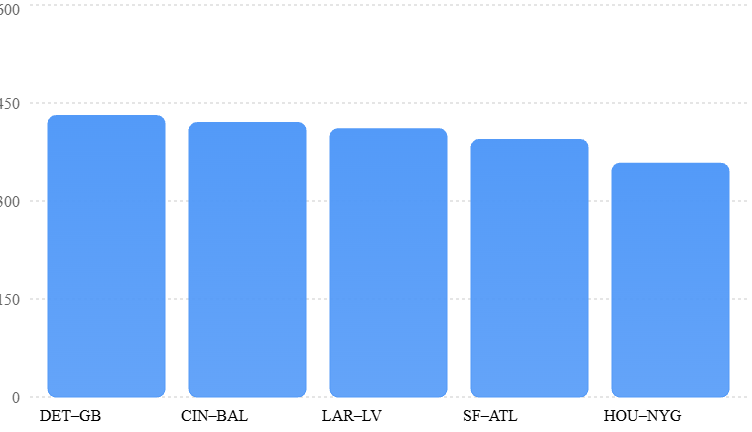
Combined offensive SACP by matchup
| Rank | Matchup | O/U | Combined SACP | Primary attraction |
|---|---|---|---|---|
| 1 | DET–GB | 53.5 | 430.8 | Best overall |
| 2 | CIN–BAL | 48.0 | 420.1 | QB leverage |
| 3 | SF–ATL | 49.5 | 394.3 | Elite RB/TE ceilings |
| 4 | LAR–LV | 48.5 | 410.7 | Strong full onslaught |
| 5 | HOU–NYG | 42.5 | 357.7 | Contrarian passing stack |
Environment interpretation
DET–GB: The strongest combination of listed game total and offensive SACP. Gibbs, Amon-Ra, Watson, and Love create multiple scoring paths. The main concern is duplicated chalk combinations.
CIN–BAL: Burrow, Chase, Higgins, and Flowers make this attractive for correlated tournaments. Baltimore’s quarterback situation is an important condition before treating this as a fully validated onslaught.
SF–ATL: Purdy, Kittle, McCaffrey, Bijan, and London all have meaningful upside. London offers the best ownership discount among the featured pass catchers.
LAR–LV: Puka has the slate’s strongest individual SACP, while Stafford is only 3.9% owned. Bowers provides a high-ceiling bring-back.
HOU–NYG: Houston’s Stroud–Collins connection offers a relatively low-owned way to pursue passing-game upside. The weaker game total makes it more speculative.
An important distinction: LAR–LV has more combined SACP than SF–ATL, but SF–ATL ranks ahead because of its stronger listed Vegas total and multiple elite individual ceiling options. These are judgment-based rankings, not outputs from a calibrated game-correlation model.
6. Best full onslaught/game-stack environments
Full onslaughts are most appealing when both teams have players capable of benefiting from the same high-scoring game script.
| Rank | Game | Primary stack | Bring-back | Risk |
|---|---|---|---|---|
| 1 | CIN–BAL | Burrow + Chase + Higgins | Flowers | Medium-high |
| 2 | LAR–LV | Stafford + Puka | Bowers + Jeanty | Medium-high |
| 3 | DET–GB | Love + Watson + Golden | Amon-Ra or Gibbs | Medium |
| 4 | SF–ATL | Purdy + Kittle | Drake London | Medium |
| 5 | HOU–NYG | Stroud + Collins | Confirmed NYG receiver | High |
Preferred tournament structures

Highest-priority aggressive stack: Burrow double-stack
Burrow + Chase + Higgins, with Flowers as the bring-back. This attacks Cincinnati’s passing ceiling while taking advantage of Burrow’s 6.8% projected ownership.

Best differentiated superstar stack: Stafford–Puka
Stafford + Puka + Bowers. Stafford’s low ownership provides a different construction around the slate’s highest-ceiling receiver.

Best high-total alternative: Love passing stack
Love + Watson, with Gibbs or Amon-Ra returning. This leverages the 53.5 listed game total without relying on the most popular QB.
These are correlation templates for an optimizer, not completed lineups. They still need to pass salary, slate-eligibility, and active-player checks.
7. Recommended bring-back structures
| Primary QB | Stack targets | Preferred bring-back | Alternative |
|---|---|---|---|
| Joe Burrow | Chase, Higgins | Zay Flowers | Derrick Henry |
| Jordan Love | Watson, Golden | Amon-Ra | Jahmyr Gibbs |
| Jared Goff | Amon-Ra, LaPorta | Christian Watson | Matthew Golden |
| Brock Purdy | Kittle | Drake London | Bijan Robinson |
| Matthew Stafford | Puka | Brock Bowers | Ashton Jeanty |
| C.J. Stroud | Nico Collins | Active NYG receiver | No forced bring-back |
Bring-back rules: In high-total competitive games, one opposing player is a sensible starting point. A second bring-back becomes more appealing in aggressive double-stack onslaughts when the opposing offense has two strong individual ceilings.
For lower-total games, particularly Houston–New York, don’t force a bring-back merely for correlation. A strong one-sided passing stack can still succeed.
8. SE vs. 3-Max priorities
| Decision | Single-Entry | 3-Max |
|---|---|---|
| QB | Purdy, Love, Burrow | Burrow, Stafford, Love |
| Elite RB | Bijan or Gibbs | Bijan, Gibbs, Taylor |
| Elite WR | Puka or Chase | Puka, Chase, Collins |
| TE | Kittle or Bowers | Bowers, McBride, Kittle |
| Game environment | DET–GB, SF–ATL | CIN–BAL, LAR–LV, DET–GB |
| Ownership approach | Selective leverage | More aggressive differentiation |
| Stack construction | QB + 1–2 pass catchers | QB + 2 pass catchers + bring-back |
Single-Entry approach
I favor a balanced construction with one elite RB or WR, one high-upside correlated passing stack, and a lower-owned separator.
For example, Bijan as an anchor alongside a Love passing stack is a reasonable way to combine raw ceiling with game-environment exposure.
3-Max approach
I’d diversify the three entries by quarterback and game environment rather than simply swapping one receiver:
Entry 1 — High-total environment
Balanced
Jordan Love + Packers pass catcher + Detroit bring-back.
Entry 2 — Contrarian ceiling
Leverage
Joe Burrow + Chase/Higgins + Baltimore bring-back.
Entry 3 — Superstar onslaught
High variance
Matthew Stafford + Puka + Brock Bowers, with Jeanty as an optional second return.
9. Key fragile-chalk/fade considerations
Not every popular play is bad chalk. The goal is to identify where ownership exceeds the advantage offered by the player’s ceiling.
| Player | RST% | Concern | Recommendation |
|---|---|---|---|
| Puka Nacua | 35.0% | Popular and expensive | Retain; differentiate elsewhere |
| Jahmyr Gibbs | 33.4% | $9,800 salary and RB opportunity cost | Pivot selectively to Bijan |
| George Kittle | 28.6% | Concentrated TE ownership | Bowers/McBride alternatives |
| Amon-Ra St. Brown | 26.2% | Popular DET exposure | Chase or London pivots |
| Kyren Williams | 23.8% | Competes with Puka for offensive scoring | Prefer in selected game scripts |
| Bo Nix | 20.2% | Popular value QB | Burrow/Love/Stroud alternatives |
| Woody Marks | 45.6% | Extreme ownership concentration | Investigate role and projection |
Most actionable leverage decisions
Gibbs vs. Bijan: Bijan has only 2.2 fewer SACP points, costs $1,300 less, and carries 11.3 percentage points less ownership.
Kittle vs. Bowers: Both have nearly identical P95 outcomes. Kittle is considerably cheaper, but Bowers is much less owned.
Puka vs. Collins/London: Puka’s raw ceiling is materially higher, but Collins and London can create significant ownership leverage in builds that otherwise feature popular players.
Nix vs. Burrow: Nix is a superior salary saver; Burrow provides a less popular route to similar modeled SACP.
These are conditional fades, not declarations that the popular players are poor plays.
10. Final condensed player pool and slate strategy
This is the reduced tournament pool I would prioritize for further optimization.
Condensed player pool
| Position | Core ceiling | Leverage targets | Value alternatives |
|---|---|---|---|
| QB | Purdy, Burrow | Love, Stafford, Stroud | Nix |
| RB | Bijan, Gibbs | Taylor, Henry | Bucky Irving, Jeanty |
| WR | Puka, Chase | Collins, London | Coker, Watson |
| TE | Bowers, Kittle | McBride | LaPorta, Kraft, Fannin |
| DST | Houston, Minnesota | Denver | Jets, Browns |
My five highest-priority tournament decisions
01
Prioritize Bijan as a Gibbs alternative.
The ceiling gap is small enough to make the ownership and salary savings attractive.
02
Retain Puka exposure without making every lineup dependent on him.
He leads the slate in modeled individual ceiling, but 35% ownership creates substantial duplication risk.
03
Build around low-owned quarterbacks with strong receiving partners.
Burrow, Love, and Stafford are my preferred tournament-stack candidates.
04
Use tight end as a separator.
Bowers and McBride provide ways to move away from Kittle ownership while maintaining strong modeled ceilings.
05
Concentrate correlated stacks in the strongest environments.
DET–GB offers the best overall environment, while CIN–BAL and LAR–LV are my preferred aggressive stacking opportunities.
Diamond Life final verdict
PREFERRED TOURNAMENT FOUNDATION
Primary RB anchor
Bijan Robinson
Highest raw ceiling
Puka Nacua
Leverage QB
Joe Burrow
Leverage WR
Nico Collins
TE separator
Trey McBride
Top game environment
DET–GB
Bottom line: This slate offers enough low-owned ceiling that we do not need to abandon strong chalk to build differentiated tournament entries. My preferred approach is one or two elite ceiling anchors, a correlated quarterback stack, and two carefully selected ownership separators.
Before importing the pool into Stokastic, validate injuries, starting roles, team assignments, and contest eligibility. The current solver export contains projections that may not reflect confirmed active rosters, and those checks are especially important for the recommended game stacks.
Download Diamond Life NFL Solver #45
Fan Duel – Full Tournament Slate Report | October 24, 2026
This report combines our Monte Carlo right-tail framework, SACP ceiling modeling, salary-adjusted value, and RST% ownership leverage to identify the strongest NFL DFS tournament opportunities.
Our primary objective is first-place upside, not simply maximizing projected fantasy points.
General discussion: Game environments and slate identity
Three major themes stand out from this slate:
- Detroit–Green Bay is the premier scoring environment. The 53.5-point Vegas total aligns with strong solver ceilings on both offenses. Jared Goff provides a significant ownership advantage over Jordan Love.
- Baltimore–Cincinnati and Los Angeles–Las Vegas offer enormous concentrated ceiling potential. Both feature elite pass catchers and quarterbacks with relatively modest ownership.
- Running back and defense offer particularly attractive leverage decisions. Bijan Robinson retains nearly all of Jahmyr Gibbs’ modeled ceiling at substantially lower ownership, while Tennessee’s projected 52.9% defensive ownership creates an opportunity to differentiate.
Top game total
53.5
DET–GB
Top player SACP
50.5
Puka Nacua
Highest DST RST%
52.9%
Tennessee
Our strategy should be to build around one strong offensive game environment, preserve exposure to elite raw ceiling, and use two or three carefully selected ownership pivots to create separation.
The following analysis uses the previously reported Solver #44 outputs. Player status, Vegas inputs and ownership have not been independently refreshed; recommendations remain conditional on confirmed availability.
1. Top solver plays by position
These rankings emphasize SACP as the primary ceiling metric while incorporating projected ownership to evaluate tournament usefulness.
Quarterbacks
| Rank | Player | Salary | SACP | RST% |
|---|---|---|---|---|
| 1 | Brock Purdy | $8,500 | 33.8 | 10.8% |
| 2 | Joe Burrow | $8,300 | 33.1 | 10.0% |
| 3 | Bo Nix | $7,200 | 32.3 | 9.7% |
| 4 | Jordan Love | $7,600 | 31.9 | 27.5% |
| 5 | Jared Goff | $8,000 | 31.5 | 9.0% |
Solver preference: Purdy for raw ceiling, Bo Nix for salary-adjusted ceiling, and Goff for ownership leverage against Love.
Running backs
| Rank | Player | Salary | SACP | RST% |
|---|---|---|---|---|
| 1 | Jahmyr Gibbs | $9,800 | 48.3 | 38.9% |
| 2 | Bijan Robinson | $9,400 | 46.6 | 24.6% |
| 3 | Christian McCaffrey | $8,700 | 39.2 | 19.3% |
| 4 | Kyren Williams | $7,900 | 38.6 | 22.8% |
| 5 | Jonathan Taylor | $8,500 | 34.4 | 10.1% |
Solver preference: Bijan offers the most attractive balance of premium ceiling and ownership. Gibbs remains the strongest raw RB play, but his popularity reduces his tournament differentiation.
Wide receivers
| Rank | Player | Salary | SACP | RST% |
|---|---|---|---|---|
| 1 | Puka Nacua | $9,100 | 50.5 | 29.6% |
| 2 | Amon-Ra St. Brown | $9,000 | 37.6 | 20.0% |
| 3 | Ja’Marr Chase | $8,800 | 36.5 | 16.4% |
| 4 | Zay Flowers | $7,800 | 35.8 | 17.6% |
| 5 | Christian Watson | $7,400 | 35.8 | 21.2% |
Solver preference: Nacua for slate-breaking raw ceiling, Chase for premium WR leverage, and Watson for exposure to the highest-total game.
Tight ends
| Rank | Player | Salary | SACP | RST% |
|---|---|---|---|---|
| 1 | Brock Bowers | $8,000 | 34.0 | 9.8% |
| 2 | George Kittle | $6,500 | 33.9 | 14.3% |
| 3 | Trey McBride | $7,200 | 28.4 | 8.4% |
| 4 | Sam LaPorta | $5,700 | 24.5 | 8.5% |
| 5 | Isaiah Likely | $5,500 | 23.4 | 8.3% |
Solver preference: Kittle stands out as one of the best salary-adjusted plays on the entire slate. Bowers offers similar raw ceiling at lower ownership but costs $1,500 more.
Defenses
| Rank | Defense | Salary | SACP | RST% |
|---|---|---|---|---|
| 1 | Houston Texans | $5,000 | 22.9 | 11.9% |
| 2 | Minnesota Vikings | $4,800 | 20.7 | 5.4% |
| 3 | New York Jets | $4,900 | 20.2 | 7.7% |
| 4 | Cleveland Browns | $4,600 | 19.6 | 4.0% |
| 5 | Denver Broncos | $4,500 | 19.2 | 4.6% |
Solver preference: Houston for ceiling; Cleveland and Minnesota for leverage against the heavily owned Tennessee defense.
2. Best spend-ups
| Player | Position | Salary | SACP | RST% | Priority |
|---|---|---|---|---|---|
| Puka Nacua | WR | $9,100 | 50.5 | 29.6% | Elite anchor |
| Bijan Robinson | RB | $9,400 | 46.6 | 24.6% | Leverage anchor |
| Jahmyr Gibbs | RB | $9,800 | 48.3 | 38.9% | Raw ceiling |
| Christian McCaffrey | RB | $8,700 | 39.2 | 19.3% | Premium pivot |
| Ja’Marr Chase | WR | $8,800 | 36.5 | 16.4% | Stack anchor |
| Brock Bowers | TE | $8,000 | 34.0 | 9.8% | Positional leverage |
The most important spend-up decision is Gibbs versus Bijan.
Premium RB ceiling versus ownership
Comparison of SACP and projected ownership for the two premium running backs.

■ SACP
■ RST%
Bijan retains 96.5% of Gibbs’ SACP with 14.3 percentage points less ownership and $400 in salary savings.
For SE, either can be justified depending on the rest of the lineup. For 3-Max, I prefer allocating greater exposure to Bijan while keeping Gibbs in the pool.
Nacua remains my preferred raw-ceiling receiver anchor. However, Chase is a strong alternative when the lineup is built around Burrow and Cincinnati’s passing attack.
3. Best values
These are players with attractive salary-adjusted right-tail access. Value does not necessarily mean low ownership.
| Player | Position | Salary | P95 | SACP | RST% |
|---|---|---|---|---|---|
| Bo Nix | QB | $7,200 | 32.7 | 32.3 | 9.7% |
| George Kittle | TE | $6,500 | 33.7 | 33.9 | 14.3% |
| Woody Marks | RB | $6,200 | 29.5 | 29.1 | 14.7% |
| Jalen Coker | WR | $6,200 | 30.2 | 29.9 | 19.3% |
| Sam LaPorta | TE | $5,700 | 24.9 | 24.5 | 8.5% |
| Isaiah Likely | TE | $5,500 | 23.9 | 23.4 | 8.3% |
| Tucker Kraft | TE | $5,500 | 22.5 | 21.9 | 7.6% |
Best QB value — Bo Nix: Only 1.5 SACP behind Purdy while saving $1,300. His modest ownership strengthens his tournament appeal.
Best positional value — George Kittle: Almost identical ceiling to Bowers, with meaningful salary savings. Kittle is a strong way to access San Francisco’s passing game.
Best RB value — Woody Marks: His 29.1 SACP provides usable midrange ceiling without requiring a premium RB salary.
Best WR value — Jalen Coker: His 30.2 P95 makes him attractive at $6,200, but his 19.3% projected ownership means he is more of a salary-relief option than a true sleeper.
4. Best sleepers/right-tail separators
This is where our tournament approach becomes more aggressive. We want players with meaningful ceiling access whose projected ownership has not fully caught up.
| Player | Position | Salary | SACP | RST% | Separation angle |
|---|---|---|---|---|---|
| Geno Smith | QB | $6,900 | 27.0 | 1.9% | Contrarian QB |
| Michael Penix | QB | $6,900 | 25.1 | 0.9% | Deep-field stack |
| Breece Hall | RB | $6,900 | 26.3 | 4.5% | Low-owned RB |
| Chase Brown | RB | $7,800 | 27.3 | 5.9% | RB pivot |
| Justin Jefferson | WR | $8,400 | 32.3 | 10.8% | Premium separator |
| Josh Downs | WR | $6,100 | 16.6 | 2.7% | Contrarian WR |
| Harold Fannin | TE | $5,400 | 20.8 | 5.5% | TE salary relief |
| Mike Gesicki | TE | $5,200 | 15.8 | 2.5% | Low-owned TE |
Highest-priority separators
Justin Jefferson: His 32.3 SACP and 10.8% ownership make him an interesting alternative to the more popular elite receivers. He provides meaningful ceiling without requiring an obscure punt.
Breece Hall: A lower-owned RB option at 4.5%. His 26.3 SACP is below the premium tier, but he creates a different roster construction.
Geno Smith: At 1.9%, he is an aggressive GPP option. His 27.0 SACP requires a favorable game script and effective stacking to overcome the ceiling gap versus Purdy and Burrow.
Harold Fannin: A useful salary-saving TE with 20.8 SACP and just 5.5% projected ownership.
The key is not to roster sleepers simply because they are unpopular. Their lower ownership must compensate for the reduction in ceiling relative to stronger alternatives.
5. Top five game environments
The following games are the preferred environments from our earlier game-level solver review.
| Rank | Matchup | Vegas O/U | Combined SACP | Primary opportunity |
|---|---|---|---|---|
| 1 | DET–GB | 53.5 | 340.8 | Highest scoring expectation |
| 2 | BAL–CIN | 48.0 | 350.2 | Highest aggregate ceiling |
| 3 | LAR–LV | 48.5 | 341.2 | Elite WR/TE upside |
| 4 | SF–ATL | 49.5 | 332.1 | RB ceiling and QB stacks |
| 5 | CAR–TB | 44.5 | 311.7 | Contrarian game stack |
Combined SACP represents modeled player-ceiling availability across an entire game, not a projection for a single lineup. The values above are from the earlier game review.
Game-by-game tournament interpretation
1. Detroit–Green Bay — Best overall
The highest Vegas total aligns with multiple strong solver plays. Goff’s 31.5 SACP at 9.0% ownership is especially attractive compared with Love’s 31.9 SACP at 27.5%.
Best use: Goff-led passing stacks with a Green Bay bring-back.
2. Baltimore–Cincinnati — Best concentrated ceiling
Burrow, Chase, Higgins and Flowers create an appealing two-sided passing environment. The aggregate SACP is highest among the five selected games.
Best use: Burrow + Chase + Flowers, with Higgins available for deeper stacks.
3. Los Angeles Rams–Las Vegas — Best premium pass-catcher combination
Nacua’s slate-leading 50.5 SACP and Bowers’ 34.0 create a compelling two-sided ceiling combination. Stafford’s 4.9% ownership offers quarterback leverage.
Best use: Stafford + Nacua + Bowers.
4. San Francisco–Atlanta — Best premium RB environment
Bijan and McCaffrey both offer significant right-tail outcomes, while Purdy and Kittle form an attractive passing-game combination.
Best use: Purdy + Kittle + London, with Bijan as an alternative standalone anchor.
5. Carolina–Tampa Bay — Best contrarian game
Bryce Young’s 30.7 SACP at 4.8% ownership provides an interesting alternative to the more popular quarterbacks. Coker and McMillan provide stacking options.
Best use: Young + McMillan or Coker + a Tampa Bay bring-back.
6. Best full onslaught/game-stack environments
A full onslaught involves concentrated exposure to both sides of one game, typically through a quarterback, two pass catchers, and one or two opposing players.
This is most useful when both teams have credible scoring ceilings and the lineup benefits from a competitive, pass-heavy game script.
| Rank | Game | Recommended construction | GPP suitability |
|---|---|---|---|
| 1 | DET–GB | Goff + St. Brown + LaPorta + Watson | SE / 3-Max |
| 2 | BAL–CIN | Burrow + Chase + Higgins + Flowers | 3-Max / Large field |
| 3 | LAR–LV | Stafford + Nacua + Kyren + Bowers | 3-Max |
| 4 | SF–ATL | Purdy + Kittle + McCaffrey + London | 3-Max |
| 5 | CAR–TB | Young + McMillan + Coker + Irving | Large field |
My favorite onslaught: Detroit–Green Bay
The combination of a 53.5 Vegas total and multiple strong ceilings makes this the most natural game to attack aggressively.
A Goff-led stack can capture Detroit’s passing production while benefiting from Green Bay responding through Watson or another receiver.
The main risk is that Detroit’s touchdowns flow through Gibbs rather than the passing game. For that reason, I prefer Goff double stacks only when their projected ceiling justifies the additional roster concentration.
Best leverage onslaught: Baltimore–Cincinnati
Burrow + Chase + Higgins + Flowers creates a correlated passing-game construction with multiple high-ceiling receivers.
The upside is substantial if both teams are forced into sustained passing volume. The risk is paying for multiple expensive receivers without receiving enough concentrated touchdowns.
Best differentiated onslaught: Rams–Raiders
Stafford + Nacua + Bowers offers exposure to three strong solver plays, including a relatively low-owned quarterback.
Adding Kyren increases exposure to the same game but may reduce the lineup’s dependence on a pure passing shootout.
7. Recommended bring-back structures
Bring-backs are particularly valuable when an opposing player’s success helps create additional offensive volume for your primary stack.
| Primary QB | Stack partner | Bring-back | Alternative |
|---|---|---|---|
| Jared Goff | Amon-Ra St. Brown | Christian Watson | Matthew Golden |
| Joe Burrow | Ja’Marr Chase | Zay Flowers | Derrick Henry |
| Matthew Stafford | Puka Nacua | Brock Bowers | Ashton Jeanty |
| Brock Purdy | George Kittle | Drake London | Bijan Robinson |
| Bryce Young | Tetairoa McMillan | Bucky Irving | Chris Godwin |
| Jordan Love | Christian Watson | Amon-Ra St. Brown | Jahmyr Gibbs |
Structural priorities
For SE: A quarterback + one receiver + one opposing bring-back is generally sufficient. This preserves roster flexibility and limits unnecessary correlation risk.
For 3-Max: Quarterback + two receivers + one opposing bring-back is attractive in the highest-ceiling passing environments.
For large-field GPPs: Consider quarterback + two receivers + two opposing players selectively, especially in Detroit–Green Bay and Baltimore–Cincinnati.
Avoid forcing a bring-back simply for correlation. A weak opposing player does not become a strong tournament play merely because they fit a stack.
8. SE vs. 3-Max priorities
Our objective changes slightly depending on contest size.
Single-Entry emphasizes strong ceiling, manageable ownership and fewer speculative roster decisions. Three-Max allows us to introduce more aggressive stacks and lower-owned pivots.
| Position | Single-Entry priority | 3-Max leverage priority |
|---|---|---|
| QB | Brock Purdy / Joe Burrow | Goff / Nix / Stafford |
| RB | Bijan / Gibbs | McCaffrey / Breece Hall |
| WR | Nacua / Chase | Jefferson / Watson |
| TE | Kittle / Bowers | LaPorta / Fannin |
| DST | Houston | Cleveland / Minnesota |
Single-Entry strategy
I would concentrate on three potential quarterback anchors:
- Brock Purdy: highest quarterback SACP.
- Joe Burrow: strong raw ceiling and attractive Cincinnati stack.
- Jared Goff: strongest direct ownership leverage against Jordan Love.
At RB, Bijan is particularly appealing because he provides almost the same modeled ceiling as Gibbs with meaningfully less ownership.
At WR, Nacua remains difficult to ignore because of his slate-leading SACP. However, pairing him with multiple highly owned players can create a lineup that is too common.
Preferred SE construction: One strong quarterback stack, one premium RB, one premium WR, a salary-efficient TE, and a defense that avoids the most concentrated ownership.
3-Max strategy
Three differentiated lineup concepts
Lineup concept 1 — Strong ceiling
Balanced
Goff + St. Brown + Watson
Use Bijan as the premium RB anchor. Prioritize raw ceiling while differentiating at quarterback.
Lineup concept 2 — Passing-game upside
Correlated
Burrow + Chase + Flowers
Build around a competitive Baltimore–Cincinnati passing environment, using a lower-owned defense.
Lineup concept 3 — Aggressive leverage
Contrarian
Stafford + Nacua + Bowers
Capture premium receiver and tight-end ceilings through a lower-owned quarterback construction.
These are stack cores, not complete lineups. Each requires salary, positional eligibility, injury and roster-correlation checks before entry.
9. Key fragile-chalk/fade considerations
Fragile chalk does not mean a player is a bad projection. It means the ownership concentration may exceed the advantage offered by the player’s ceiling.
| Player / DST | RST% | SACP | Concern | Preferred alternative |
|---|---|---|---|---|
| Tennessee DST | 52.9% | 18.5 | Extreme defensive ownership | Cleveland / Minnesota |
| Jahmyr Gibbs | 38.9% | 48.3 | Premium salary and ownership | Bijan Robinson |
| Puka Nacua | 29.6% | 50.5 | Expensive popular WR | Ja’Marr Chase |
| Jordan Love | 27.5% | 31.9 | QB ownership concentration | Jared Goff |
| Kyren Williams | 22.8% | 38.6 | Popular RB in crowded environment | McCaffrey |
| Christian Watson | 21.2% | 35.8 | Potentially popular GB stack | Jefferson |
| Jalen Coker | 19.3% | 29.9 | Midrange value becoming popular | Alternative WR construction |
Four important decisions
1. Tennessee DST — strongest fade candidate
The 52.9% ownership projection is exceptionally high for a defense. Cleveland and Minnesota offer higher modeled SACP with substantially less ownership.
I would be willing to pay additional salary for that leverage, provided the remaining roster still has enough offensive ceiling.
2. Jordan Love — preferred ownership fade at QB
Love has a 31.9 SACP compared with Goff’s 31.5. That small ceiling difference does not justify ignoring Goff’s much lower ownership.
This is one of the cleanest quarterback pivots on the slate.
3. Gibbs — underweight rather than automatic fade
Gibbs leads RBs in SACP. Completely fading him sacrifices meaningful raw ceiling.
However, Bijan’s 46.6 SACP at 24.6% ownership makes an underweight Gibbs strategy reasonable for tournament play.
4. Nacua — good chalk worth retaining
Nacua’s 50.5 SACP is substantially higher than every other receiver. His ownership is significant, but the ceiling advantage is also meaningful.
Rather than automatically fading Nacua, I prefer using him alongside lower-owned quarterback stacks, RBs and defenses.
10. Final condensed player pool and slate strategy
This is the working pool I would take into Stokastic for tournament lineup construction, subject to final availability checks.
Condensed player pool
| Position | Core ceiling | Leverage | Value / sleeper |
|---|---|---|---|
| QB | Purdy, Burrow | Goff, Stafford | Nix, Young |
| RB | Bijan, Gibbs | McCaffrey, Jonathan Taylor | Woody Marks, Breece Hall |
| WR | Nacua, Chase | Jefferson, St. Brown | Watson, Coker |
| TE | Kittle, Bowers | McBride, LaPorta | Likely, Fannin |
| DST | Houston | Cleveland, Minnesota | Denver |
Final strategic ranking
1
Prioritize Bijan as a premium RB leverage anchor
The combination of 46.6 SACP and 24.6% ownership is one of the slate’s strongest ceiling-versus-popularity relationships.
2
Attack Detroit–Green Bay through Goff
A 53.5 game total and Goff’s 9.0% ownership create a strong alternative to popular Love constructions.
3
Retain access to Nacua’s elite ceiling
His 50.5 SACP leads the slate. Differentiating elsewhere may be more effective than automatically fading him.
4
Exploit Kittle’s salary-adjusted ceiling
His 33.9 SACP is essentially tied with Bowers while costing $1,500 less.
5
Use defense as a major separation point
Tennessee’s 52.9% projected ownership creates a strong reason to consider Cleveland, Minnesota and Houston.
Final Diamond Life assessment
The slate offers several ways to create leverage without sacrificing too much raw ceiling.
My preferred foundation is Bijan Robinson at RB, George Kittle at TE, and a Goff, Burrow or Purdy quarterback stack, while selectively maintaining exposure to Puka Nacua.
For 3-Max, I particularly like varying the game environment rather than simply swapping one player across otherwise identical lineups.
The most important lesson from this slate is that we don’t need to abandon elite plays to become different. We can retain premium ceilings and gain meaningful separation through quarterback ownership, game-stack construction, and defensive pivots.


Leave a Reply